
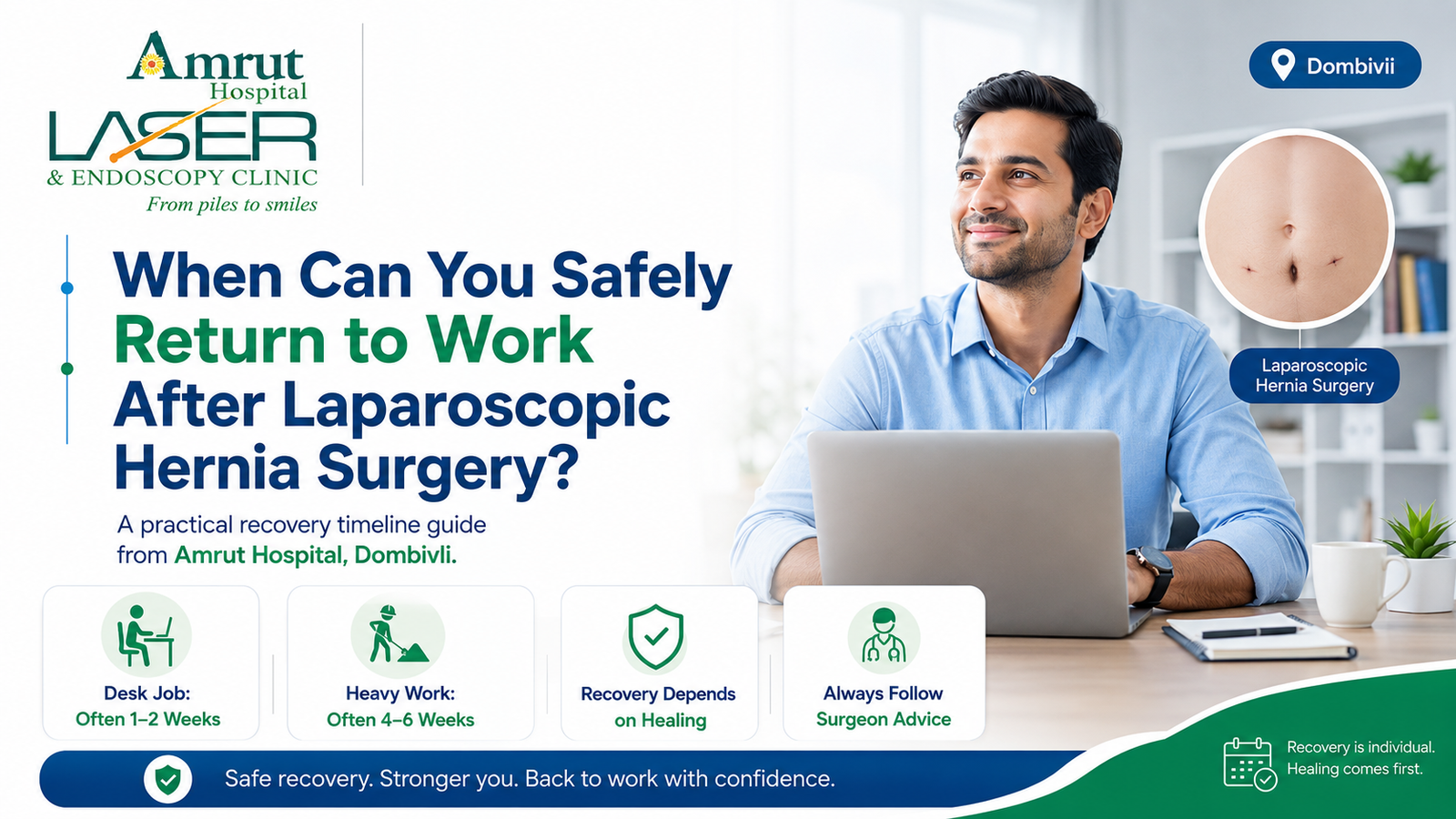
One of the first questions working patients ask is, “How soon can I return to work after laparoscopic hernia surgery?” It is an understandable concern. You may have office responsibilities, a business to manage, household work or a job that involves lifting and travelling.
The small incisions used in laparoscopic surgery may make the recovery look simple from the outside. However, the tissues inside the abdomen still need time to heal. Returning too early may increase soreness, tiredness and discomfort.
The right recovery period depends on the type and size of the hernia, the surgery performed, your general health and the physical demands of your job.
At Amrut Hospital in Dombivli, patients receive recovery guidance based on their actual work routine. A person working on a computer may return sooner than someone who lifts boxes, drives long distances or stands throughout the day.
Understanding the recovery process can help you return safely without placing unnecessary pressure on the repaired area.
Worried About Missing Work? Here’s When You Can Return After Laparoscopic Hernia Surgery
Most patients can return to work after laparoscopic hernia surgery within one to two weeks if they have a desk-based job and an uncomplicated recovery. People whose work involves heavy lifting, repeated bending or strenuous activity may need four to six weeks. The final timeline should always be confirmed by the treating surgeon.
What Is Laparoscopic Hernia Surgery?
Laparoscopic hernia surgery is a minimally invasive procedure used to repair a weak spot or opening in the abdominal wall.
A hernia develops when fat, tissue or part of an internal organ pushes through this weak area. It may appear as a visible bulge in the groin, around the navel or near the scar of an earlier operation.
During laparoscopic surgery, the surgeon makes a few small incisions. A small camera and specialised instruments are inserted through these openings. The tissue is placed back in its correct position, and the weakness is repaired. Surgical mesh may be used when medically suitable.
Laparoscopic and robotic hernia repairs use small incisions and specialised instruments. Suitable patients may experience an easier recovery and an earlier return to normal activities compared with some open procedures.
However, laparoscopic surgery is not automatically suitable for every hernia. The surgeon considers its size, location, complexity, previous operations and the patient’s health before recommending a procedure.
Why Is Recovery Time Different for Every Patient?
There is no single recovery schedule that works for everyone. Two patients may undergo hernia surgery on the same day but return to work at different times.
Important factors include:
- Type of hernia: Inguinal, umbilical, femoral, ventral and incisional hernias may require different repairs.
- Size of the hernia: A larger or more complex hernia may require a longer recovery.
- Surgical technique: Laparoscopic, robotic and open procedures have different recovery considerations.
- Type of work: Desk work usually places less strain on the abdomen than lifting or manual labour.
- Pain level: Increasing or uncontrolled pain may mean that more rest or evaluation is needed.
- General health: Diabetes, obesity, smoking and other health conditions may affect healing.
- Previous surgery: Scar tissue or a recurrent hernia can make the operation more complex.
- Post-surgery complications: Infection, fever, vomiting or increasing swelling may delay recovery.
Your surgeon will also consider whether you can sit comfortably, walk safely, travel to work and complete your normal duties without excessive strain.
How Can You Safely Return to Work After Laparoscopic Hernia Surgery?
A gradual recovery is usually safer than suddenly restarting your complete routine.
Step 1: Start Gentle Movement
Patients are generally encouraged to begin gentle movement when medically safe. Short walks can support circulation and reduce stiffness.
Do not remain in bed throughout the day unless your doctor has specifically advised it. At the same time, do not force yourself to walk through sharp or increasing pain.
Step 2: Manage Pain Properly
Take pain-relief medicines exactly as prescribed. Good pain control can make it easier to walk, sleep and perform basic activities.
Do not increase or stop medicines without speaking to your doctor.
Step 3: Protect the Surgical Area
Follow the wound-care instructions provided before discharge. Keep the area clean and dry as advised.
Avoid tight clothing, sudden twisting and movements that pull strongly around the abdomen.
Step 4: Prevent Constipation
Constipation and straining can place pressure on the abdomen. Drink enough water, eat fibre-rich foods and use prescribed stool softeners when recommended.
Do not delay the urge to pass stool. Speak to your surgeon if constipation continues despite following the recovery plan.
Step 5: Restart Desk Work Gradually
Many patients can return to work after laparoscopic hernia surgery in approximately one to two weeks when their duties are light.
A phased return may be more comfortable. You may begin with shorter hours, work from home or take regular walking breaks.
Avoid sitting in the same position for several hours. Stand up and walk gently whenever possible.
Step 6: Delay Heavy Physical Work
People working in construction, delivery, warehousing, manufacturing, fitness or other physically demanding fields usually need more time.
Guidance from recognised surgical and health organisations commonly recommends longer leave when work involves heavy lifting. Depending on the operation and the surgeon’s instructions, this may extend to four to six weeks.
Step 7: Attend the Follow-Up Appointment
The follow-up visit is important even when you feel better. Your surgeon will assess the wound, pain, swelling and movement before clearing you for full duties.
Do not judge your recovery only by the appearance of the small external cuts. Internal healing may still be taking place.
- Desk-based work: often around 1–2 weeks
- Light duties: may restart gradually
- Heavy manual work: often 4–6 weeks
- Final clearance: depends on the surgeon’s assessment
- Increasing pain or swelling: needs medical advice
What Are the Benefits of Laparoscopic Hernia Surgery?
For suitable patients, laparoscopic hernia repair may provide several practical benefits:
- Smaller incisions
- Less visible scarring
- Earlier walking and light movement
- Shorter hospital stay in selected cases
- Faster return to normal routine for many patients
- Ability to evaluate both groin areas during some procedures
- Less wound discomfort in certain cases
The American College of Surgeons notes that patients may often return to non-lifting work after one to two weeks following laparoscopic or open groin hernia repair. It also reports that laparoscopic repair may support a faster return to normal activity for suitable patients.
These benefits do not guarantee that everyone will return to work after laparoscopic hernia surgery at the same speed. Recovery still depends on the individual patient and the complexity of the repair.
Laparoscopic Hernia Surgery vs Open Hernia Surgery
| Factor | Laparoscopic hernia surgery | Open hernia surgery |
|---|---|---|
| Incisions | A few small incisions | Usually one larger incision |
| Anaesthesia | Commonly general anaesthesia | General, regional or local anaesthesia may be possible |
| Early movement | Usually encouraged | Usually encouraged |
| Desk-work recovery | Often around one to two weeks | May be similar or slightly longer |
| Heavy lifting | Restricted until medically cleared | Restricted until medically cleared |
| Bilateral hernias | Both sides may be treated through the same small incisions | Separate access may be needed |
| Suitability | Suitable for selected patients | Suitable for many simple and complex cases |
Neither method is right for every person.
A qualified Laparoscopic surgeon in Dombivli will examine the hernia and explain why a laparoscopic or open repair is being recommended. The decision should be based on safety, not only on incision size or recovery expectations.
Who Is a Good Candidate for Laparoscopic Hernia Surgery?
Laparoscopic surgery may be considered for patients who have:
- An inguinal, umbilical, ventral or incisional hernia
- Hernias on both sides of the groin
- A recurrent hernia after previous open surgery
- Pain or heaviness affecting work and daily activities
- A growing hernia
- A hernia that becomes visible while coughing or standing
- Medical fitness for general anaesthesia
- A preference for minimally invasive treatment when clinically appropriate
Not everyone should immediately undergo surgery. Some small and minimally symptomatic hernias may be observed under medical guidance.
However, a hernia usually does not close on its own. Surgery is the only treatment that repairs the actual weakness in the abdominal wall.
Seek urgent medical care if the lump becomes suddenly painful, firm or impossible to push back, especially when accompanied by vomiting, fever or abdominal swelling.
How Much Does Laparoscopic Hernia Surgery Cost in Dombivli?
The cost of laparoscopic hernia surgery is not the same for every patient.
Pricing may depend on:
- Type and size of the hernia
- Whether it is a new or recurrent hernia
- Complexity of the operation
- Laparoscopic or open technique
- Type and size of mesh, when required
- Surgeon and anaesthesia charges
- Hospital stay
- Diagnostic tests
- Medicines and dressings
- Insurance coverage
- Follow-up requirements
A proper estimate can usually be given only after examination.
Ask whether the quotation includes mesh, investigations, hospital charges, medicines and post-surgery follow-ups. This can help prevent confusion about additional expenses later.
What Are the Hernia Surgery Trends in 2026?
Hernia treatment in 2026 is becoming more patient-specific. Surgeons are moving away from treating every hernia with the same technique.
Important trends include:
- Individualised selection of open, laparoscopic or robotic surgery
- Greater use of minimally invasive techniques for suitable patients
- Better pre-surgery assessment of weight, diabetes and smoking
- Early walking and structured recovery plans
- Improved pain-management methods
- Careful selection and placement of surgical mesh
- Greater attention to patient-reported comfort and quality of life
- Clearer return-to-work planning based on occupation
- Shared decision-making between the patient and surgeon
Current surgical guidance continues to emphasise that hernia repair is not a one-size-fits-all procedure. Treatment should be adapted to the patient, the hernia and the risk of recurrence.
Technology is useful, but the surgeon’s judgement and experience remain essential.
Why Choose Amrut Hospital in Dombivli?
Amrut Hospital provides consultation and surgical care for hernia, piles, fissure, fistula, gallbladder and other general surgical conditions in Dombivli East.
The hospital lists laparoscopic surgery, hernia surgery, endoscopy and laser treatment among its available services.
Patients can consult Amrut Hospital for:
- Assessment by a Hernia surgeon in Dombivli
- Guidance from a Laparoscopic surgeon in Dombivli
- Evaluation by an Endoscopic surgeon in Dombivli
- Open and laparoscopic hernia treatment
- Post-surgery activity and work guidance
- Piles, fissure and fistula evaluation
- Personalised follow-up care
Patients searching for laser piles treatment in Dombivli can also receive examination and treatment guidance at Amrut Hospital. The hospital offers piles care, hernia surgery and endoscopic services under one setup.
Hernia surgery and a laser operation for piles in Dombivli are different treatments. Symptoms such as bleeding, swelling, pain or a lump should be properly examined before choosing any procedure.
A consultation at a Piles clinic in Dombivli can help identify whether rectal symptoms are caused by piles, fissure, fistula or another condition.
Patients looking for a Piles doctor in Dombivli or a Piles hospital in Dombivli should choose treatment based on diagnosis rather than assuming that every symptom requires laser surgery.
Frequently Asked Questions
1. Can I Return to Work After Laparoscopic Hernia Surgery in One Week?
Some patients with desk-based jobs may feel comfortable returning after one week. Others may need around two weeks.
You should be able to walk, sit, travel and concentrate comfortably before restarting work.
2. When Can I Start Lifting After Hernia Surgery?
Heavy lifting should be avoided until the surgeon provides clearance.
The restriction may last for several weeks depending on the hernia, repair technique and physical demands of your job.
3. Is Walking Safe After Laparoscopic Hernia Surgery?
Gentle walking is usually encouraged after surgery. Start with short distances and gradually increase your activity.
Stop and contact your doctor if walking causes severe pain, dizziness, breathlessness or increasing swelling.
4. Can a Hernia Return After Surgery?
A hernia can recur after any repair.
Smoking, obesity, infection, chronic coughing, constipation and excessive strain may increase the risk. Following the surgeon’s recovery instructions can help protect the repair.
5. Does Amrut Hospital Offer Laser Piles Treatment in Dombivli?
Amrut Hospital provides consultation and laser piles treatment in Dombivli for suitable patients after proper examination. It also provides care for fissure, fistula, hernia and other general surgical conditions.
Laser treatment is not necessary for every piles patient. The correct option depends on the grade of piles, symptoms and response to medicines or lifestyle changes.
Book a Hernia Consultation at Amrut Hospital
Your job matters, but so does giving your body enough time to heal.
Before you return to work after laparoscopic hernia surgery, tell your surgeon exactly what your daily work involves. Mention lifting, driving, prolonged sitting, standing, climbing stairs and travelling.
This information allows the doctor to recommend a realistic recovery period instead of giving general advice.
Consult Amrut Hospital in Dombivli for hernia evaluation, treatment planning and personalised post-surgery guidance. A planned recovery can help you return to work with greater comfort and confidence.
Book your consultation with Amrut Hospital and receive clear guidance for a safer return to your normal routine.