
Have you ever experienced sudden pain in the upper right side of your stomach after eating a heavy meal? Or felt uncomfortable, nauseous, or bloated after eating oily food?
Many people ignore these symptoms, thinking they are caused by acidity or indigestion. But sometimes, the real problem could be gallstones or another gallbladder condition.
Finding out that you have gallstones can be worrying, especially when your doctor mentions surgery. You may wonder, “Can medicines dissolve the stones?” or “Is removing the entire gallbladder really necessary?”
The answer depends on your symptoms, the size and location of the stones, and whether complications have developed.
At Amrut Hospital, patients seeking Gallbladder Surgery in Dombivli can consult Dr. Pramod D. Bahekar for an evaluation of gallbladder problems and suitable treatment options.
Understanding laser piles treatment in dombivli is needed as it can help you make an informed decision without unnecessary fear.
This guide explains the warning signs, causes, treatment choices, surgical process, and recovery after gallbladder removal.
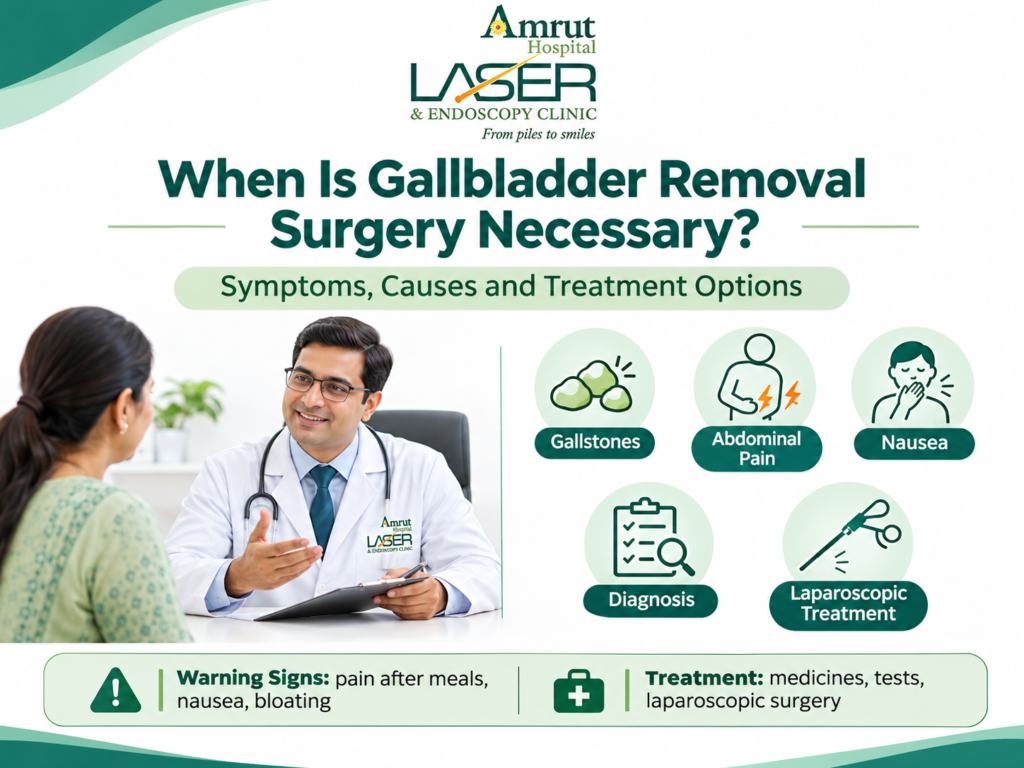
When Is Gallbladder Removal Surgery Necessary?
Gallbladder removal surgery is usually recommended when gallstones cause repeated abdominal pain, inflammation, infection, or complications such as blocked bile ducts or pancreatitis. However, gallstones without symptoms often do not require surgery. Doctors consider ultrasound findings, symptoms, medical history, and overall health before deciding whether gallbladder removal is necessary.
What Is Gallbladder Removal Surgery?
Gallbladder removal surgery, medically called cholecystectomy, is a procedure that removes the gallbladder when it causes significant health problems.
The gallbladder is a small, pear-shaped organ located beneath the liver. It stores bile, a digestive fluid produced by the liver that helps break down fats.
Sometimes, substances in bile form hardened deposits called gallstones. These stones may remain harmless or block the normal flow of bile.
When blockage occurs, it can trigger severe pain, inflammation, or infection.
The two main surgical methods are:
- Laparoscopic gallbladder surgery: A minimally invasive procedure using small incisions, a camera, and surgical instruments.
- Open gallbladder surgery: A procedure involving a larger incision, sometimes required in complicated cases.
People can live without a gallbladder because the liver continues producing bile for digestion.
What Causes Gallbladder Problems, and When Should You Be Concerned?
Gallbladder problems may develop gradually. Some people have stones for years without experiencing symptoms, while others develop sudden pain.
Common causes and risk factors
- Excess cholesterol in bile: Cholesterol can form crystals that eventually become stones.
- Excess bilirubin: Certain medical conditions may increase bilirubin and contribute to pigment stones.
- Poor gallbladder emptying: Bile that remains in the gallbladder may become concentrated.
- Obesity or rapid weight loss: Both can increase the risk of gallstones.
- Family history and hormonal factors: These may also influence gallstone formation.
Symptoms you should not ignore
Upper abdominal pain
Pain beneath the right ribs, sometimes spreading to the back or right shoulder, especially after meals.
Nausea and vomiting
Feeling sick during painful gallbladder attacks, sometimes with vomiting.
Discomfort after eating
Gallbladder-related pain may become noticeable after fatty or heavy meals.
Fever, chills, yellowing of the skin or eyes, or severe persistent abdominal pain may indicate a complication requiring urgent medical attention.
For instance, someone who experiences repeated pain after dinner should not keep taking acidity medicines without checking the actual cause. An ultrasound may reveal gallstones that need further assessment.
Medical reference: Gallstones — Symptoms, Causes and Treatment.
How Does Gallbladder Removal Surgery Work? Step-by-Step Process
If your doctor recommends surgery, knowing what happens next can make the experience less stressful.
Step 1: Consultation and diagnosis
The doctor reviews your symptoms, medical history, and previous treatment.
An abdominal ultrasound is commonly used to detect gallstones. Blood tests may check for inflammation, infection, and liver or pancreatic problems.
Step 2: Choosing the right treatment
Not every patient needs an operation.
If gallstones are causing repeated attacks or complications, your surgeon may recommend laparoscopic surgery in Dombivli.
Step 3: Preparing for surgery
Before surgery, your healthcare team reviews your medicines and overall health, explains the risks, and provides fasting instructions.
Step 4: Performing the procedure
During laparoscopic surgery, the surgeon makes small incisions in the abdomen.
A camera helps the surgeon view the area while specialized instruments are used to remove the gallbladder.
The operation is usually performed under general anaesthesia.
Step 5: Recovery and follow-up
Many patients can return home the same day or after an overnight stay, depending on their condition.
Light activity is encouraged as advised, while heavy lifting and strenuous activity are temporarily restricted. NHS+1
What Should Patients Remember?
- Gallstones do not always require surgery.
- Repeated pain or complications may make surgery necessary.
- Laparoscopic surgery is commonly used when suitable.
- Recovery depends on the procedure and individual health.
- A surgical consultation helps determine the safest next step.
What Are the Benefits of Laparoscopic Gallbladder Surgery?
For suitable patients, laparoscopic surgery offers several advantages over traditional open surgery.
- Smaller incisions: The procedure uses several small cuts instead of one large incision.
- Less postoperative discomfort: Many patients experience less pain than with open surgery.
- Shorter hospital stay: Some patients can return home on the day of surgery.
- Earlier return to activities: People with desk jobs may return to work within one to two weeks, depending on recovery.
- Prevention of further gallbladder attacks: Removing the gallbladder prevents new stones from forming inside that organ.
However, all operations carry risks, including bleeding, infection, bile leakage, bile duct injury, and anaesthesia-related complications. Some patients may temporarily experience loose stools after surgery.
Your doctor will explain the expected benefits and possible risks based on your health.
Gallbladder Surgery vs Medicines: Which Treatment Is Better?
One of the most common questions patients ask is, “Why remove the gallbladder when medicines are available?”
Some medicines can dissolve certain small cholesterol stones, but treatment may take months or years. Stones can also return after successful medical treatment.
Here’s how the options compare.
| Treatment | When it may be used | Important consideration |
|---|---|---|
| Observation | Gallstones without symptoms | Regular assessment if symptoms develop |
| Medicines | Selected cholesterol stones | Slow results; stones may return |
| Laparoscopic surgery | Symptomatic gallstones or certain complications | Removes the gallbladder |
| Open surgery | Complex or difficult surgical cases | Longer recovery is common |
| ERCP | Stones blocking the common bile duct | Clears duct stones; does not remove the gallbladder |
Cite: National Institute of Diabetes and Digestive and Kidney Diseases
Dietary changes may help reduce symptoms, but they do not reliably dissolve existing gallstones.
The right treatment is not always the most advanced one. It is the one that addresses the patient’s condition safely.
Who Needs Gallbladder Removal Surgery?
Doctors may recommend gallbladder removal when a patient has:
- Repeated gallstone attacks that affect daily activities.
- Acute or recurring gallbladder inflammation, called cholecystitis.
- Gallstones causing complications such as pancreatitis.
- Bile duct problems associated with gallstones.
- Certain gallbladder polyps or other conditions requiring specialist assessment.
Imagine a working professional who experiences severe abdominal pain every few weeks. Medicines may temporarily control the pain, but the attacks keep returning.
In such cases, a gallstone doctor in Dombivli may recommend surgery after reviewing the investigation results.
On the other hand, a person whose gallstones were discovered during a routine scan, without any symptoms, may not require immediate treatment.
This is why medical evaluation matters more than the size or number of stones alone.
How Much Does Gallbladder Surgery Cost in Dombivli?
The cost of gallbladder surgery can vary depending on the patient’s condition, surgical technique, hospital stay, and medical requirements.
Factors that may affect the final cost include:
- Type of surgery: Laparoscopic or open gallbladder removal.
- Diagnostic tests: Ultrasound, blood investigations, and other necessary tests.
- Complexity: Inflammation, infection, or bile duct complications.
- Hospital stay: Same-day discharge or additional observation.
- Medicines and follow-up: Recovery-related care and prescribed treatment.
- Insurance coverage: The patient’s policy terms and hospital arrangements.
If you are exploring gallstone treatment in Dombivli, ask for a written estimate and clarify what is included before scheduling a planned procedure.
What Are the Latest Trends in Gallbladder Surgery in 2026?
Gallbladder surgery continues to benefit from developments in minimally invasive techniques and surgical safety.
Three important areas of focus in 2026 include:
1. Minimally invasive surgery
Laparoscopic cholecystectomy remains a widely used surgical approach. Smaller incisions can support shorter hospital stays and earlier recovery for suitable patients.
2. Greater attention to bile duct safety
Modern surgical guidelines emphasize careful identification of the anatomy before gallbladder removal. In selected situations, imaging during surgery can help surgeons assess the bile ducts and reduce the risk of injury.
3. Individualized treatment decisions
Surgeons consider the severity of inflammation, associated medical conditions, imaging results, and possible complications before selecting a surgical approach.
These developments highlight why choosing an appropriate laparoscopic surgeon in Dombivli and discussing treatment risks is important.
Why Choose Amrut Hospital in Dombivli for Gallbladder Treatment?
When abdominal pain keeps returning, patients need more than temporary relief. They need a clear diagnosis, understandable advice, and a treatment plan suited to their condition.
At Amrut Hospital, Dr. Pramod D. Bahekar provides surgical consultation and care for gallbladder problems, including gallstones and related conditions.
Patients considering Gallbladder Surgery in Dombivli can seek guidance on:
- Gallbladder symptoms and diagnostic investigations.
- Whether medicines, observation, or surgery are appropriate.
- Laparoscopic gallbladder removal for suitable patients.
- Pre-surgery preparation and postoperative care.
- Recovery, dietary guidance, and follow-up.
Amrut Hospital also provides care for other general and gastrointestinal surgical conditions.
Other Surgical Services Available at Amrut Hospital
Patients may also consult the hospital for related or separate conditions, including:
- Piles Surgery in Dombivli: Piles treatment in Dombivli, hemorrhoids treatment in Dombivli, and laser piles surgery in Dombivli. Patients searching for a piles doctor in Dombivli, piles clinic in Dombivli, or piles hospital in Dombivli can seek an evaluation.
- Laser Fissure Surgery in Dombivli: Fissure treatment in Dombivli and anal fissure treatment in Dombivli, with consultation from a fissure doctor in Dombivli.
- Fistula Laser Surgery in Dombivli: Assessment of anal fistula symptoms and treatment options based on the fistula’s anatomy.
- Hernia Surgery in Dombivli: Hernia treatment in Dombivli, including assessment by a hernia doctor in Dombivli or hernia specialist in Dombivli.
- Endoscopy Surgery in Dombivli: Diagnostic endoscopy services for suitable patients seeking an endoscopy doctor in Dombivli, endoscopy centre in Dombivli, or gastro endoscopy in Dombivli.
- Laparoscopic Surgery in Dombivli: Minimally invasive surgical care for selected conditions at a laparoscopic hospital in Dombivli.
- Anal Cancer Surgery in Dombivli: Patients concerned about possible anal cancer symptoms should seek assessment and, when required, referral for anal cancer treatment in Dombivli through an appropriately qualified anal cancer doctor in Dombivli or anal cancer specialist in Dombivli.
These conditions require different examinations and treatment plans. Having one digestive symptom does not mean you have another surgical condition.
Frequently Asked Questions (FAQs)
1. Can gallstones be treated without removing the gallbladder?
Yes. Gallstones without symptoms often need no treatment. Certain cholesterol stones may respond to medicines, but this approach is suitable only for selected patients. Symptomatic gallstones commonly require surgery.
2. Is gallbladder removal a major surgery?
Gallbladder removal is an abdominal operation performed under general anaesthesia. Laparoscopic surgery is minimally invasive, but it still carries surgical risks. Recovery depends on the patient’s condition and the procedure performed.
3. How long does recovery take after gallbladder surgery?
Many patients return to light activities within days and desk-based work within one to two weeks after laparoscopic surgery. Recovery from open surgery usually takes longer.
4. What happens if gallstones are left untreated?
Gallstones that do not cause symptoms may remain harmless. However, symptomatic stones can cause repeated pain, inflammation, infection, bile duct blockage, or pancreatitis. Seek urgent care for severe persistent pain, fever, or jaundice.
5. Can you live a normal life after gallbladder removal?
Yes. Most people can live normally without a gallbladder. The liver continues to produce bile, although some patients initially notice changes in digestion or bowel movements.
For further information contact:
Amrut Hospital
Address: Dr R.P. Rd, Dombivli, Tilak Nagar, Dombivli East, Kalyan, Maharashtra 421201
Phone: 9920070956