

Piles can make even simple daily activities feel uncomfortable. Sitting at work, walking to the market, exercising, traveling, or even using the toilet may suddenly make you wonder, “Am I making my piles worse?”If pain, bleeding, swelling, itching, or discomfort keeps returning despite lifestyle changes, it is important to seek proper medical advice. Visiting a Piles hospital in Dombivli can help you understand the cause of your symptoms and whether simple lifestyle changes, medicines, or further treatment may be needed.
The good news is that you usually do not need to stop moving completely. In fact, staying moderately active can support healthy bowel movements and may help reduce constipation one of the common linked with piles. Regular physical activity is also recommended as part of constipation prevention.
However, not every activity affects piles in the same way. Heavy lifting, repeated straining, long periods of sitting, and spending too much time on the toilet may increase pressure around the rectal area.
If bleeding, pain, swelling, itching, or discomfort keeps returning despite lifestyle changes, it may be time to speak with a Piles doctor in Dombivli. Depending on the diagnosis and severity, treatment options may range from conservative care to procedures such as laser piles treatment in Dombivli.
Is Walking Good for Piles?
Yes, gentle walking is generally good for people with piles because regular physical activity may support bowel movement and reduce constipation. However, walking does not directly cure piles. Avoid activities involving excessive straining or heavy lifting during a flare-up, and consult a doctor if bleeding, severe pain, or recurring symptoms continue.
What Is Walking’s Role in Managing Piles?
Walking is a low-impact physical activity that keeps the body moving without placing the same strain on the abdomen and pelvic area as very heavy exercise.
Piles, also called haemorrhoids, are swollen tissues and blood vessels around the anus or lower rectum. Constipation, straining during bowel movements, sitting on the toilet for long periods, chronic diarrhea and frequent heavy lifting are among the factors associated with haemorrhoids.
Walking does not shrink an existing haemorrhoid by itself. What it may do is support better bowel habits.
Regular movement may help:
- Support normal digestive activity
- Reduce the likelihood of constipation
- Break up long periods of sitting
- Support healthy body weight
- Encourage a more active daily routine
Think of walking as part of supportive piles care not as a replacement for medical treatment when treatment is actually needed.
Why Do Daily Activities Matter When You Have Piles?
Your everyday routine can influence how much pressure and irritation the anal and rectal area experiences.
Common habits that may affect symptoms include:
- Long sitting hours: Sitting continuously, especially on the toilet, may increase pressure around the anal veins.
- Constipation: Hard stools may lead to repeated straining.
- Heavy lifting: Regular heavy lifting can increase abdominal pressure and may aggravate haemorrhoid problems in some people.
- Low-fiber meals: Less fiber may contribute to harder stools and difficult bowel movements.
- Not drinking enough fluids: Adequate fluids help dietary fiber work effectively.
- Ignoring the urge to pass stool: Delaying bowel movements may make stool harder for some people.
- Regular movement: Staying physically active may help prevent constipation.
For example, imagine someone working at a desk in Dombivli for eight or nine hours every day. They barely get up, drink little water and then spend 15 minutes straining in the toilet at night. Adding short walking breaks may be far more helpful than remaining seated throughout the day.
How Does Walking Help With Piles Step by Step?
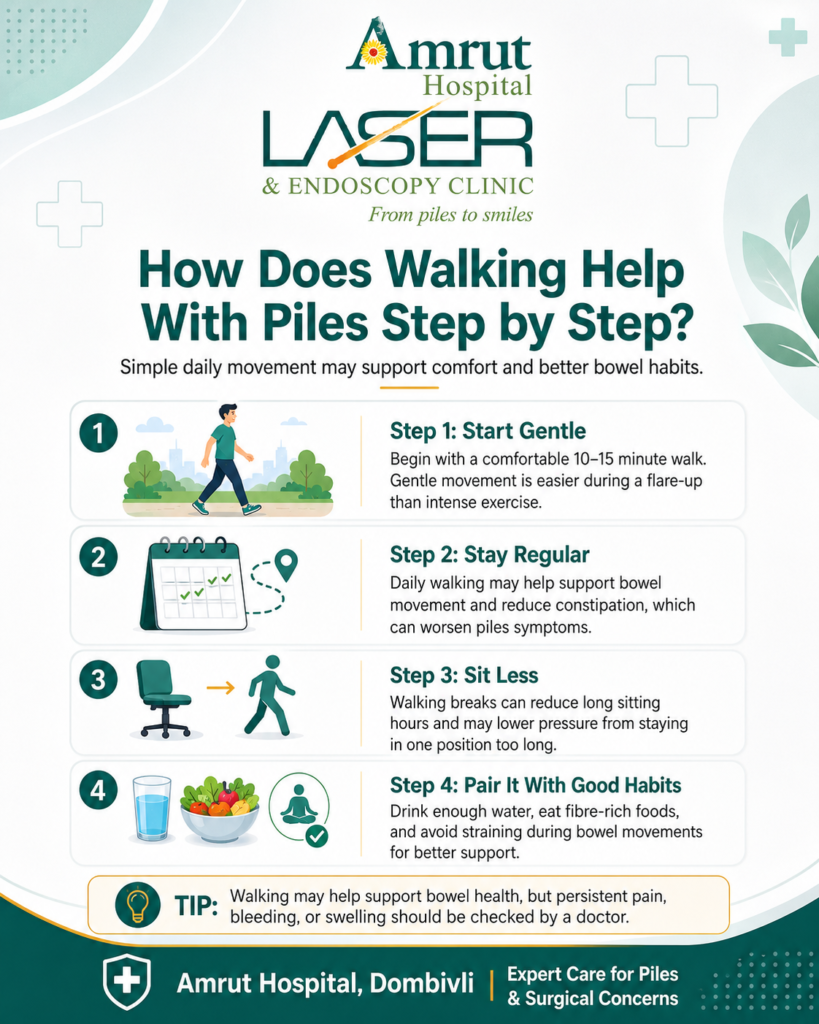
Walking mainly helps indirectly by supporting habits that can reduce constipation and unnecessary straining.
Step 1: Start with comfortable movement
A gentle 10–15 minute walk can be a practical starting point if you have been inactive.
You do not need an intense workout. Comfort matters, especially when piles are painful or swollen.
Step 2: Break long sitting periods
If your work involves sitting for hours, stand up and walk around periodically.
Even walking to refill your water bottle or moving around the office is better than staying in one position all day.
Step 3: Combine activity with fiber
Physical activity works best alongside healthy bowel habits.
Fruits, vegetables, whole grains, pulses and other fiber-rich foods can help produce softer, easier-to-pass stools. NIDDK notes that adults generally need roughly 22–34 grams of fiber per day, depending on age and sex.
Step 4: Drink adequate fluids
Fiber needs fluid to work properly.
Your ideal fluid intake depends on your health, climate and activity level, so people with fluid restrictions should follow their doctor’s advice.
Step 5: Avoid straining in the toilet
Walking all day cannot cancel out 15 minutes of forceful straining.
When you pass stool, avoid forcing it unnecessarily and avoid sitting on the toilet for long periods.
Walking may support piles management mainly by encouraging regular activity and reducing constipation risk. Pair it with fiber, adequate fluids and healthy toilet habits. If symptoms continue despite these steps, medical evaluation is more useful than simply increasing exercise.
What Are the Benefits of Walking When You Have Piles?
For most people, comfortable walking is one of the easier activities to include in daily life.
Potential benefits include:
- Supports regular bowel habits
- May help reduce constipation
- Breaks up prolonged sitting
- Requires no special equipment
- Can be adjusted according to comfort
- Supports general fitness and weight management
- Is easier on the body than strenuous lifting
Exercise is encouraged as part of haemorrhoid prevention, but there is no specific exercise proven to make existing piles disappear.
Which Daily Activities May Help or Worsen Piles Symptoms?
| Daily Activity | Usually Helpful or Caution? | Why? |
|---|---|---|
| Gentle walking | Helpful | Supports activity and bowel regularity |
| Light household activity | Usually helpful | Keeps the body moving |
| Sitting for many hours | Caution | Prolonged sitting may increase pressure |
| Sitting on the toilet for long periods | Avoid | Can increase pressure around haemorrhoids |
| Heavy weightlifting with straining | Caution | May increase abdominal and rectal pressure |
| Drinking adequate water | Helpful | Supports softer stools when combined with fibre |
| Fibre-rich meals | Helpful | Can make stools easier to pass |
| Straining during bowel movements | Avoid | Major factor associated with haemorrhoids |
| Ignoring repeated bleeding | Avoid | Rectal bleeding should be medically assessed |
NIDDK specifically recommends high-fiber foods, adequate fluids, avoiding straining, limiting prolonged toilet sitting and avoiding regular heavy lifting as part of haemorrhoid prevention and management.
Who Is a Good Candidate for Walking and Who Needs Medical Care?
Most people with mild piles symptoms can continue gentle physical activity according to comfort.
Walking may be especially useful for people who:
- Have a sedentary job
- Sit for long periods
- Experience occasional constipation
- Are trying to improve bowel habits
- Want a low-impact activity
But there is a point where lifestyle changes are not enough.
Consider visiting a Piles clinic in Dombivli if you experience:
- Repeated rectal bleeding
- Persistent pain
- A painful or swollen lump
- Prolapse during bowel movements
- Symptoms that repeatedly return
- Symptoms that do not improve after home care
Rectal bleeding should not automatically be assumed to be piles because other digestive conditions can also cause bleeding.
What Are the Cost and Pricing Factors for Piles Treatment?
Walking itself costs nothing, and conservative management may be enough for some mild cases.
When medical treatment is required, however, the cost can vary depending on:
- Type and grade of piles
- Consultation and examination required
- Diagnostic tests, if needed
- Medicines or conservative therapy
- Type of procedure recommended
- Anesthesia requirements
- Hospital or day-care charges
- Follow-up requirements
- Insurance coverage
Not every patient visiting a Piles hospital in Dombivli will require surgery.
Similarly, laser operation for piles in Dombivli should only be considered after examination and discussion of suitable alternatives rather than being chosen simply because it uses newer technology.
What Are the Piles Treatment Trends in 2026?
Piles care in 2026 is becoming increasingly focused on matching the treatment to the severity of the disease rather than using the same procedure for everyone.
Clinical guidelines continue to place dietary and behavioral changes among first-line measures. For suitable Grade I and II piles, and selected Grade III cases that do not improve with conservative treatment, office procedures such as rubber-band ligation may be considered. More advanced disease may require surgical treatment.
Minimally invasive techniques, including laser haemorrhoidoplasty, continue to attract interest because research has reported benefits such as lower early postoperative pain and faster return to routine activities compared with conventional haemorrhoidectomy in selected patients.
However, newer evidence also highlights an important trade-off: faster short-term recovery does not automatically mean better long-term results for every patient. Some recent analyses describe uncertainty around long-term recurrence and durability.
That is why choosing piles treatment in Dombivli should begin with diagnosis, grading and a discussion with a qualified surgeon.
Why Choose Amrut Hospital in Dombivli?
At Amrut Hospital, Dombivli, patients can seek evaluation for piles, fissure, fistula and other general surgical concerns.
The hospital provides laser, laparoscopic and endoscopic surgical services under Dr. Pramod Bahekar, with treatment decisions based on the patient’s condition and clinical assessment.
Patients looking for a Piles doctor in Dombivli can consult the team to understand whether lifestyle changes, medicines, an office procedure or a surgical option is more appropriate.
Amrut Hospital also provides access to a Hernia surgeon in Dombivli, Laparoscopic surgeon in Dombivli and Endoscopic surgeon in Dombivli for relevant surgical conditions.
Most importantly, seeking a consultation does not mean surgery is automatically required. The first goal is to understand what is actually causing the symptoms.
FAQs About Walking and Piles
1. Is a daily walk good for piles?
Yes. Gentle daily walking can support bowel regularity and may help reduce constipation. However, it does not directly cure existing piles.
2. How long should I walk if I have piles?
There is no fixed walking duration specifically for piles. Start with a comfortable amount, such as short walks, and gradually increase activity if symptoms allow. Stop and seek advice if an activity causes significant pain or bleeding.
3. Can too much walking make piles worse?
Normal comfortable walking usually does not worsen piles. However, during a painful flare-up or after a procedure, activity may need to be adjusted. Follow your surgeon’s advice during recovery.
4. Which activities should I avoid with piles?
Avoid repeated straining, prolonged toilet sitting and heavy lifting that requires forceful straining, especially when symptoms are active.
5. When should I consider laser piles treatment in Dombivli?
Consider a medical consultation when piles repeatedly bleed, prolapse, cause significant discomfort or fail to improve with conservative care. Whether laser treatment is suitable depends on the type and severity of piles and the surgeon’s assessment.
Take the Next Step Towards Comfortable Daily Living
Walking, drinking enough fluids, eating fiber-rich foods and developing healthier toilet habits may make a meaningful difference when piles are mild.
But should you keep adjusting your lifestyle month after month while bleeding or pain keeps returning? Probably not.
If symptoms persist, get them properly assessed.
For consultation regarding laser piles treatment in Dombivli, piles diagnosis or other suitable treatment options, visit Amrut Hospital, Dombivli East.
Amrut Hospital
Dr. Rajendra Prasad Road, Tilak Nagar, Near Char Rasta, Dombivli East, Thane, Maharashtra 421201
Call: 87796 02217