
Modern life rarely follows a perfect routine. A rushed breakfast, hours at a desk, delayed meals, less water, late nights and ongoing work pressure can gradually affect the way your digestive system behaves.If symptoms continue despite sensible lifestyle changes, consulting a doctor can help clarify whether conservative treatment is enough or whether a procedure such as laser piles treatment in Dombivli should be considered.
For some people, this shows up as constipation. Stools may become harder, bowel movements may become less regular, or passing stool may require more effort. When straining becomes frequent, existing piles can also become more uncomfortable.
The frustrating part is that people often focus only on temporary relief. They may change one food, try a home remedy or ignore the problem until it returns again. But recurring constipation and piles usually deserve a closer look at bowel habits, diet, hydration, activity and the actual severity of the condition.
The aim is not simply to treat a symptom. It is to understand what may be keeping the problem going.
Can Stress and an Irregular Routine Affect Constipation and Piles?
Yes. Stress and changes in daily routine can contribute to constipation by affecting digestion, eating habits, hydration, activity and bowel timing. Constipation can lead to harder stools and repeated straining, which may contribute to piles or worsen existing symptoms. Treatment depends on the cause and severity of the condition.
What Is the Link Between Stress, Irregular Routine, Constipation and Piles?
Piles, also called haemorrhoids, are swollen veins in the lower rectum or around the anus. They may develop or become more troublesome when there is repeated pressure during bowel movements.
Constipation is commonly associated with hard or difficult-to-pass stools, fewer bowel movements than usual, straining, or a feeling that the bowel has not emptied completely.
So where does stress fit in?
Stress does not mean that someone will automatically develop piles. However, stress can influence digestive function and may also change everyday habits. A person under pressure may eat at irregular times, drink less water, exercise less or repeatedly postpone going to the toilet.
Consider a typical office day. You leave home in a hurry, ignore the morning bowel urge, sit through meetings, drink several cups of tea but little water, eat late and reach home exhausted. If this becomes your daily pattern, bowel regularity may suffer.
Constipation and repeated straining are recognized factors associated with haemorrhoids. This is why treating the bowel habit is often just as important as treating the piles themselves.
Mini Summary:
Stress is not considered a direct cause of piles. The concern is that stress and an irregular lifestyle may contribute to constipation, while repeated straining can increase pressure on haemorrhoidal veins.
Why Can Stress and an Irregular Lifestyle Make Bowel Problems Worse?
Several small habits can combine and gradually make bowel movements more difficult.
Common factors include:
- Not getting enough fiber: Fiber adds bulk and softness to stool, helping it move through the digestive tract.
- Low fluid intake: Adequate fluids help fiber work effectively and can support softer stools.
- Skipping or delaying meals: An unpredictable eating routine may also disturb your usual bowel routine.
- Ignoring the urge to pass stool: Repeatedly postponing bowel movements can make constipation harder to manage.
- Too little physical activity: A sedentary lifestyle may contribute to sluggish bowel movement.
- Long periods of sitting: People working desk jobs may spend most of the day with very little movement.
- Repeated straining: Straining places additional pressure on the veins around the lower rectum.
- Stressful routines: Stress may affect digestion while also influencing sleep, food choices, hydration and activity.
The National Institute of Diabetes and Digestive and Kidney Diseases recommends about 22–34 grams of fiber per day for adults, depending on age and sex. Fiber should usually be increased gradually and accompanied by adequate fluids.
That does not mean everyone with constipation simply needs more fiber. Persistent or unexplained bowel changes may require medical evaluation.
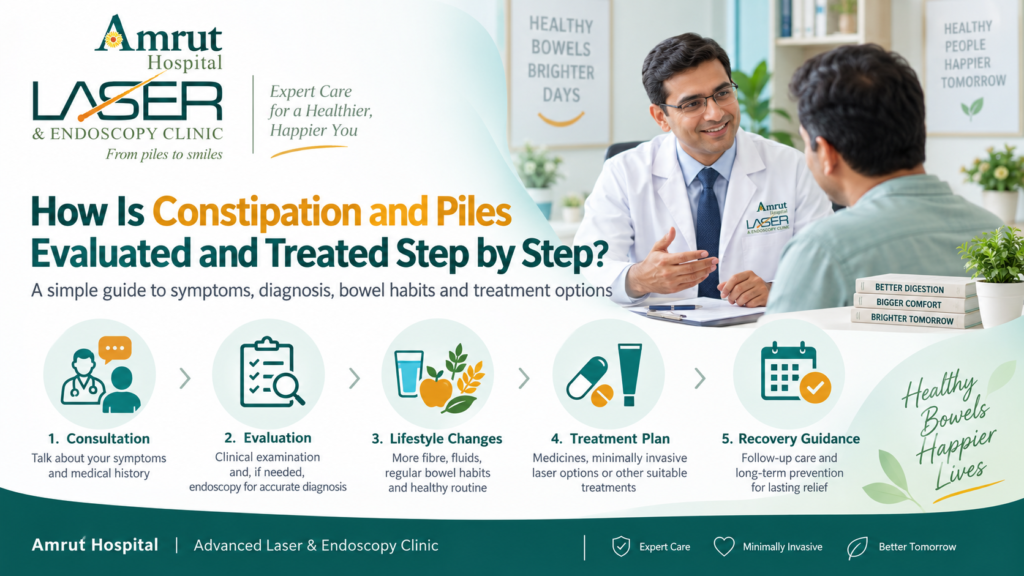
How Is Constipation and Piles Evaluated and Treated Step by Step?
Good treatment starts with finding out what is actually happening.
Step 1: Understand your bowel habits
A doctor may ask about:
- How often you pass stool
- Stool consistency
- How much you strain
- Whether bowel movements feel incomplete
- Your water and fiber intake
- Physical activity
- Medicines or supplements
- How long the symptoms have been present
These simple questions can reveal useful patterns.
Step 2: Examine the condition
Not every symptom around the anal area is caused by piles. Proper examination helps confirm the diagnosis and assess the type and severity of haemorrhoids.
This is one reason why consulting a qualified Piles doctor in Dombivli can be more useful than repeatedly self-treating the symptoms.
Step 3: Improve bowel habits
For mild constipation and early piles, the first approach may involve:
- Increasing fiber gradually
- Drinking adequate fluids
- Staying physically active
- Establishing a regular toilet routine
- Avoiding unnecessary straining
- Reducing prolonged toilet sitting
NIDDK also notes that regular physical activity and bowel training may help some people manage constipation.
Step 4: Use medicines when appropriate
A doctor may recommend medicines, fiber supplements, stool-softening measures or other treatments depending on the cause.
Avoid using laxatives or piles creams repeatedly without guidance if symptoms continue.
Step 5: Consider a procedure when required
Not every person with piles needs surgery.
Current colorectal guidelines state that many symptomatic Grade I and II haemorrhoids, and selected Grade III cases that do not improve adequately with conservative care, may be treated with office-based procedures.
For other patients, a laser operation for piles in Dombivli or another surgical approach may be discussed after proper assessment.
What Are the Benefits of Treating the Underlying Bowel Problem?
Treating piles while ignoring constipation can leave one of the main aggravating factors unchanged.
Improving bowel habits may help with:
- Softer stools
- Easier bowel movements
- Less straining
- More regular toilet habits
- Reduced irritation during bowel movements
- Shorter toilet time
- Better digestive comfort
- Reduced chance of repeatedly aggravating existing piles
- Better long-term management after piles treatment
For patients considering laser piles treatment in Dombivli, bowel management is still important before and after the procedure.
Think of it this way: treating the haemorrhoids addresses the current problem, while better bowel habits help reduce unnecessary pressure going forward.
Mini Summary:
A complete piles treatment plan should look beyond the immediate symptoms. Improving constipation, hydration, fiber intake, activity and toilet habits may support better long-term comfort.
How Does Laser Piles Treatment Compare With Other Options?
There is no single treatment that is right for every patient.
| Treatment Option | When It May Be Considered | Main Focus |
|---|---|---|
| Diet and lifestyle changes | Mild constipation or early symptoms | Improving stool consistency and reducing strain |
| Medicines | Selected mild symptoms | Managing constipation or temporary symptoms |
| Office-based procedures | Many Grade I–II and selected Grade III piles | Treating haemorrhoids without major surgery |
| Laser piles treatment | Selected patients requiring procedural treatment | Minimally invasive treatment of haemorrhoidal tissue |
| Conventional surgery | Larger, advanced or complex haemorrhoids | Surgical removal or correction when appropriate |
The correct choice depends on the grade of piles, symptoms, medical history and response to previous treatment.
A good Piles clinic in Dombivli should therefore assess the condition before recommending a specific procedure rather than assuming laser treatment is necessary for everyone.
Who Is a Good Candidate for Laser Piles Treatment in Dombivli?
You may need further evaluation when symptoms continue despite improving your bowel habits.
A doctor may discuss procedural treatment if:
- Piles repeatedly cause discomfort
- Symptoms keep returning
- Conservative treatment has not been enough
- Piles prolapse or become more advanced
- Everyday activities are being affected
- The examination shows that a procedure is appropriate
However, laser piles treatment in Dombivli is not automatically required for every patient with haemorrhoids.
Someone with mild symptoms related mainly to constipation may benefit from lifestyle and medical management. Another person with more advanced haemorrhoids may need a procedure.
Recurring bleeding should also be properly assessed rather than automatically being labeled as piles.
How Much Does Laser Piles Treatment in Dombivli Cost?
The cost of piles treatment can differ from one patient to another because the treatment plan itself may differ.
Factors that can influence the overall cost include:
- Grade and type of piles
- Procedure recommended
- Per-operative investigations
- Anesthesia
- Day-care or hospital requirements
- Medicines
- Existing health conditions
- Follow-up visits
- Insurance eligibility and coverage
For this reason, an exact treatment estimate is best provided after examination.
When comparing hospitals, it is also useful to ask what the quoted amount includes rather than choosing treatment only on the basis of the lowest advertised price.
What Are the Piles Treatment Trends in 2026?
Piles care in 2026 is increasingly centered on individualized and minimally invasive treatment, while conservative care continues to play an important role.
Current evidence-based guidance supports starting with dietary and behavioral changes for many patients. Office-based procedures remain effective for suitable early and moderate haemorrhoids, while surgery or other procedural options may be considered for more advanced disease.
Another important focus is prevention.
Instead of treating haemorrhoids as an isolated problem, doctors increasingly look at contributing factors such as constipation, prolonged straining, physical activity, fiber intake and bowel habits.
Minimally invasive technologies are also becoming more visible to patients. However, modern technology should complement good diagnosis—not replace it.
The best treatment in 2026 is still the treatment that matches the individual patient’s condition.
Why Choose Amrut Hospital in Dombivli?
Amrut Hospital is an Advanced Laser & Endoscopy Center in Dombivli East offering treatment for piles, fissure, fistula, hernia, gallbladder conditions and other general surgical concerns.
The hospital offers piles treatment in Dombivli under Dr. Pramod Bahekar, with treatment planning based on examination and the severity of the condition. Amrut Hospital’s website also highlights minimally invasive, laser, laparoscopic and endoscopic surgical care.
Patients looking for a Piles hospital in Dombivli or Piles clinic in Dombivli can receive consultation for both piles symptoms and related bowel concerns.
Amrut Hospital also provides related surgical services for people searching for a Hernia surgeon in Dombivli, Laparoscopic surgeon in Dombivli, or Endoscopic surgeon in Dombivli.
The approach is simple: understand the problem first, then choose the treatment that fits the patient.
FAQs
1. Can stress cause piles?
Stress does not directly cause piles in every person. However, stress can affect digestive habits and may contribute to constipation. If constipation leads to frequent straining, existing haemorrhoids may become more troublesome.
2. Can an irregular bowel routine cause constipation?
Yes. Frequently delaying bowel movements, inconsistent meals, low fluid intake and changes in routine may contribute to constipation. A regular toilet routine, fiber, fluids and physical activity may help.
3. When should I visit a Piles doctor in Dombivli?
Consider consulting a doctor if piles symptoms keep returning, bowel movements remain difficult despite lifestyle changes, or you develop persistent discomfort or bleeding. Proper diagnosis helps rule out other possible causes.
4. Does everyone with piles need laser treatment?
No. Mild piles may improve with bowel habit changes, fiber, fluids or medical treatment. Some patients may benefit from office-based procedures, while others may require laser or conventional surgery depending on severity.
5. Is laser operation for piles in Dombivli suitable for all grades?
Suitability for a laser operation for piles in Dombivli depends on the type and grade of haemorrhoids, symptoms, overall health and findings during examination. A surgeon should assess the patient before recommending any procedure.
Take the Next Step Towards Better Bowel Health
Constipation and piles can be uncomfortable to talk about, but ignoring recurring symptoms rarely makes them easier to manage.
If changes in diet, hydration and routine are not giving you enough relief, a proper evaluation can help you understand what is happening and what treatment you actually need.
For consultation regarding laser piles treatment in Dombivli, visit Amrut Hospital, Dombivli East. The team can assess your bowel habits, symptoms and severity before discussing conservative care, medical treatment or a suitable procedure.
Book your consultation with Amrut Hospital and take the first step towards more comfortable, regular bowel health.