
Do you enjoy morning walks, gym workouts, yoga, or staying active throughout the day? Being diagnosed with an abdominal hernia can suddenly make these everyday activities feel risky.
You may start wondering, “Can I still exercise?” or “Will lifting something heavy make my hernia worse?”
These concerns are common, especially among people who have physically demanding jobs, regularly visit the gym, or simply want to maintain a healthy lifestyle.
An abdominal hernia occurs when tissue or part of an internal organ pushes through a weak area in the abdominal wall. It may cause a visible bulge, discomfort, or pain during certain movements.
The good news? Having a hernia does not always mean you must stop being active.
However, not every exercise is suitable. Some movements can increase pressure inside your abdomen and worsen symptoms.
Understanding which activities may be safer, which ones to avoid, and when to seek medical advice can help you stay active without taking unnecessary risks.
For patients considering laser piles treatment in Dombivli, getting the right guidance early can make daily activities easier to manage.
Can You Exercise With an Abdominal Hernia?
Yes, some people with an abdominal hernia can continue gentle activities such as walking, depending on their symptoms and hernia type. However, heavy lifting, intense abdominal exercises, and movements that cause straining may worsen discomfort. Always consult a doctor before starting or continuing exercise, especially if the hernia is painful or growing.
What Is an Abdominal Hernia, and How Does It Affect Exercise?
An abdominal hernia develops when fatty tissue, intestine, or another structure pushes through a weak spot in the muscles or connective tissue of the abdominal wall.
It may appear as a small lump near the belly button, groin, or previous surgical scar.
Common types include:
- Inguinal hernia: Develops in the groin area.
- Umbilical hernia: Appears near the belly button.
- Incisional hernia: Occurs around a previous surgical incision.
- Epigastric hernia: Develops in the upper middle abdomen.
During exercise, abdominal pressure naturally increases. Certain movements, especially heavy lifting or intense core workouts, can place additional strain on the weakened area.
Not every movement will cause harm. The main concern is whether an activity increases pain, swelling, or pressure around the hernia.
A qualified hernia doctor in Dombivli can assess the condition and recommend appropriate activity limits.
Why Does Exercise Sometimes Make Hernia Symptoms Worse?
Exercise is important for overall health, but certain movements may increase pressure inside the abdomen.
Several factors can make hernia symptoms more noticeable:
- Heavy weightlifting: Straining against heavy resistance raises abdominal pressure.
- Poor breathing technique: Holding your breath while lifting can increase internal pressure.
- Intense abdominal workouts: Sit-ups, crunches, and certain planks may aggravate symptoms.
- Sudden movements: Jumping or high-impact workouts may cause discomfort.
- Existing muscle weakness: A weak abdominal wall may struggle with added physical strain.
- Ignoring symptoms: Continuing exercise despite pain can delay medical evaluation.
For example, someone who regularly lifts heavy weights might notice a groin bulge becoming more prominent during squats.
Does this mean exercise caused the hernia? Not necessarily.
A weakness may already exist, while physical strain makes the bulge or discomfort more noticeable. Cleveland Clinic+1
How Can You Exercise Safely With an Abdominal Hernia?
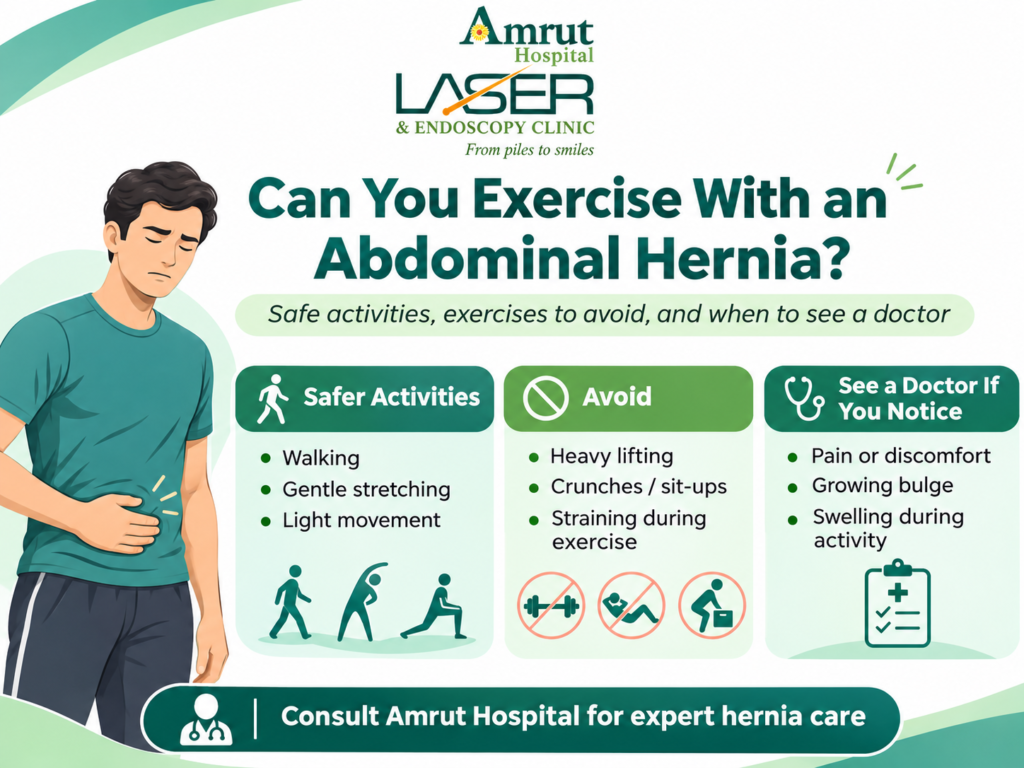
Staying active with a hernia requires the right approach. Rather than following a regular workout plan without changes, exercise should be adjusted according to medical advice.
Step 1: Get Your Hernia Examined
Before exercising, consult a doctor to understand your hernia’s type, size, symptoms, and possible risks.
Step 2: Start With Gentle Movement
Walking is often a suitable starting activity for people with uncomplicated hernias.
Begin at a comfortable pace and stop if discomfort develops.
Step 3: Avoid Excessive Straining
Avoid heavy lifting and exercises that require forceful abdominal contractions unless your surgeon specifically clears them.
Step 4: Breathe Normally
Try not to hold your breath during physical activity. Controlled breathing may help reduce unnecessary straining.
Step 5: Pay Attention to Symptoms
Stop exercising if you notice pain, increased swelling, pulling sensations, or discomfort around the hernia.
Step 6: Follow Your Doctor’s Recommendations
A surgeon may suggest activity changes, monitoring, or hernia surgery in Dombivli based on the examination.
Exercising With a Hernia
Gentle movement may be possible, but it does not repair the abdominal wall. Avoid painful or strenuous activities, seek medical clearance, and never ignore worsening symptoms.
What Are the Benefits of Staying Physically Active With a Hernia?
When approved by a healthcare professional, gentle physical activity can support overall health.
Potential benefits include:
- Maintaining mobility: Regular walking helps keep the body moving.
- Supporting healthy weight management: Appropriate activity can contribute to weight control.
- Improving circulation: Gentle movement supports normal blood flow.
- Reducing inactivity: Staying mobile helps limit stiffness caused by prolonged sitting.
- Supporting emotional well-being: Comfortable activity can help maintain confidence and routine.
However, exercise cannot close a hernia opening or replace necessary medical treatment.
Which Exercises Are Safer, and Which Should You Avoid?
Not all physical activities place the same amount of pressure on the abdomen.
The following comparison provides general guidance for people with an uncomplicated hernia.
| Activity | General guidance |
|---|---|
| Walking | Often suitable if comfortable |
| Gentle stationary cycling | May be suitable with medical approval |
| Swimming | May be suitable if symptoms allow |
| Gentle stretching | Only movements that do not strain the abdomen |
| Heavy weightlifting | Generally avoid until medically cleared |
| Sit-ups and crunches | May aggravate symptoms; avoid unless cleared |
| Heavy squats and deadlifts | Usually require modification or avoidance |
| High-impact sports | Discuss risks with your doctor |
These are general recommendations, not a personalised exercise prescription. Cleveland Clinic
Someone with a small, painless hernia may tolerate certain activities, while another person with a larger or painful hernia may need stricter limits.
Who Should Consult a Hernia Specialist Before Exercising?
Not everyone with an abdominal hernia needs immediate surgery. However, proper medical assessment is important.
Consider consulting a hernia specialist in Dombivli if you experience:
- A visible bulge that becomes larger during physical activity.
- Pain while lifting, coughing, bending, or exercising.
- Increasing heaviness or pulling sensations in the abdomen.
- Difficulty performing your regular daily activities.
- A hernia that has gradually increased in size.
When Is a Hernia a Medical Emergency?
Seek immediate emergency medical care if you experience:
- Sudden, severe abdominal or groin pain.
- A painful, firm bulge that cannot be pushed back in when it previously could.
- Vomiting, abdominal swelling, or inability to pass gas or stool.
- Redness or dark discoloration over a painful hernia.
These symptoms may suggest bowel obstruction or strangulation, which can require urgent surgery. Do not attempt to force a painful, stuck hernia back into place.
What Factors Affect the Cost of Hernia Treatment in Dombivli?
The cost of treatment depends on several medical and procedural factors.
These may include:
- Type and size of the hernia.
- Whether open or laparoscopic surgery is recommended.
- Complexity of the procedure.
- Type of mesh or surgical materials required.
- Hospital stay and anaesthesia requirements.
- Preoperative investigations and follow-up care.
Laparoscopic surgery in Dombivli may be an option for suitable patients, while open repair may be more appropriate for others.
A consultation can help patients understand the recommended procedure and obtain an individual cost estimate.
What Are the Latest Hernia Treatment Trends in 2026?
Hernia care continues to focus on patient safety, individual treatment planning, and appropriate recovery guidance.
Important developments and care priorities include:
- Personalised treatment decisions: Surgery and careful monitoring are considered according to hernia type, symptoms, and patient needs.
- Minimally invasive techniques: Laparoscopic approaches remain important options for selected patients.
- Early mobility: Modern recovery guidance often encourages suitable movement soon after surgery.
- Activity-based recovery: Returning to exercise depends on the procedure, healing, and surgeon’s advice.
- Shared decision-making: Patients are encouraged to discuss benefits, risks, and alternatives before treatment.
Research published in 2025 also highlighted the importance of individualised guidance on returning to physical activity after hernia repair. PubMed Central
Why Choose Amrut Hospital | Piles Fistula and Fissure Doctor in Dombivli?
At Amrut Hospital | Piles Fistula and Fissure Doctor in Dombivli, patients can receive surgical consultations and treatment planning based on their medical needs.
Under the guidance of Dr. Pramod D. Bahekar, the hospital provides evaluation and open or laparoscopic treatment options for different types of hernias.
Patients can discuss symptoms, suitable treatment options, possible complications, and recovery precautions before making a decision.
Along with hernia care, the hospital offers laparoscopic surgery in Dombivli, stOther services include piles surgery in Dombivli, piles treatment in Dombivli, hemorrhoids treatment in Dombivli, laser piles treatment in Dombivli, laser fissure surgery in Dombivli, and fissure treatment in Dombivli.
Patients seeking an anal fissure treatment in Dombivli, a fissure doctor in Dombivli, fistula laser surgery in Dombivli, an anal cancer doctor in Dombivli, or an anal cancer specialist in Dombivli can also enquire about the hospital’s services, including anal cancer surgery in Dombivli and anal cancer treatment in Dombivli.
For digestive concerns, services include consultation with a gallstone treatment in Dombivli, an endoscopy doctor in Dombivli, and access to an endoscopy centre in Dombivli for gastro endoscopy in Dombivli and appropriate endoscopic procedures.
Patients looking for an endoscopy surgery in Dombivli, a laparoscopic surgeon in Dombivli, a laparoscopic hospital in Dombivli, a piles doctor in Dombivli, a piles clinic in Dombivli, or a piles hospital in Dombivli can contact the hospital to enquire about available care. Hemorrhoids Treatment at Amrut Hospital
Frequently Asked Questions (FAQs)
1. Can walking make an abdominal hernia worse?
Walking is generally considered a low-impact activity and may be suitable for people with an uncomplicated hernia. However, stop if walking causes pain or increased swelling, and follow your doctor’s advice.
2. Can I go to the gym if I have a hernia?
Gym activities may need to be modified. Heavy lifting, crunches, and intense abdominal exercises can increase pressure inside the abdomen. Consult a doctor before continuing your gym routine.
3. Can exercise cure an abdominal hernia naturally?
No. Exercise cannot repair the opening in the abdominal wall. Selected hernias may be monitored, but surgery is the treatment used to repair the defect when needed.
4. Is yoga safe for someone with an abdominal hernia?
Some gentle yoga movements may be suitable, but poses involving strong abdominal pressure, deep twisting, or straining may worsen symptoms. Obtain medical advice before practising yoga.
5. How soon can I exercise after hernia surgery?
Light walking is often encouraged early after surgery, but returning to heavy lifting, gym workouts, or sports depends on the repair and your recovery. Follow your surgeon’s specific instructions.
Stay Active, but Don’t Ignore Your Hernia
An abdominal hernia does not always mean giving up exercise. Gentle physical activity may still be possible, but the right choices depend on your symptoms and medical condition.
Ignoring discomfort or pushing through painful workouts can create unnecessary risks.
If you notice a growing bulge, recurring pain, or difficulty exercising, a medical consultation can help you understand your next steps.
Looking for professional guidance about hernia symptoms or surgery?
For further information contact:
Amrut Hospital | Piles Fistula and Fissure Doctor in Dombivli
Address: Dr R.P. Rd, Dombivli, Tilak Nagar, Dombivli East, Kalyan, Maharashtra 421201
Phone: 9920070956