
Digestive discomfort is easy to dismiss when it happens once in a while. Maybe you ate something heavy, skipped a meal or had a stressful week. But what happens when acidity keeps returning, stomach pain refuses to settle or you frequently feel bloated, nauseous or uncomfortable after eating?
For many people, the first response is to try home remedies or over-the-counter medicines. These may help temporarily, but ongoing digestive symptoms deserve proper medical attention, especially when they begin affecting appetite, sleep, work or everyday life.
Sometimes, a doctor may recommend an endoscopy to look directly inside the upper digestive tract and understand what is causing the symptoms.
At Amrut Hospital, patients looking for a Piles Hospital in Dombivli can also receive evaluation for digestive and surgical concerns. Depending on the condition, this may include assessment for endoscopy, piles, fissure, fistula, hernia, gallbladder problems and other gastrointestinal conditions.
The key is not to assume the cause. The right diagnosis should come first.
When Is Endoscopy Recommended for Ongoing Digestive Symptoms?
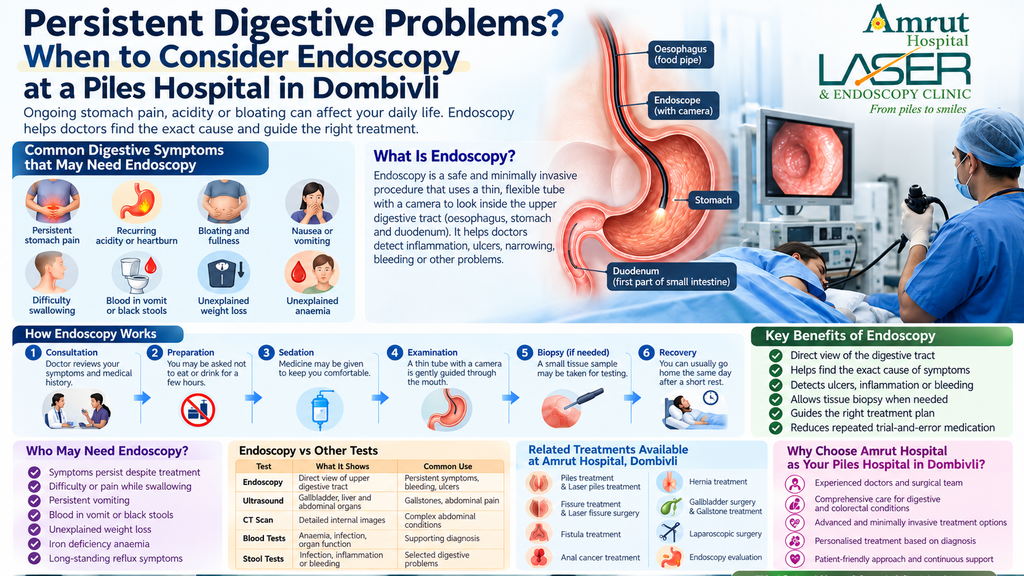
Endoscopy may be recommended when digestive symptoms such as persistent upper abdominal pain, recurring acidity, difficulty swallowing, gastrointestinal bleeding, unexplained anaemia, repeated vomiting or other concerning symptoms need further investigation. The procedure allows the doctor to examine the digestive tract directly and decide whether additional tests, medicines or treatment are required.
What Is Endoscopy?
Endoscopy is a medical procedure that allows a doctor to see the inside of the digestive tract using a thin, flexible tube with a small camera and light.
For an upper gastrointestinal endoscopy, the instrument is gently passed through the mouth to examine areas such as the:
- Oesophagus or food pipe
- Stomach
- First part of the small intestine or duodenum
The procedure can help doctors investigate inflammation, ulcers, narrowing, bleeding and other changes that may explain persistent digestive symptoms.
Endoscopy can also allow a doctor to take a small tissue sample, known as a biopsy, when medically necessary.
People searching online for Endoscopy Surgery in Dombivli should know that routine diagnostic endoscopy itself is generally considered a procedure rather than surgery. An endoscopy doctor in Dombivli determines whether it is appropriate based on symptoms, examination and medical history.
Why Is Endoscopy Needed for Persistent Digestive Problems?
Not every episode of gas, acidity or indigestion requires endoscopy. In many uncomplicated cases, doctors may first recommend lifestyle changes, medication or other non-invasive tests.
However, an endoscopy may become useful when there is a need to understand what is happening inside the digestive tract.
Common reasons include:
- Symptoms continue despite treatment: Persistent upper abdominal symptoms that do not improve after an appropriate trial of treatment may require further evaluation.
- Difficulty or pain while swallowing: Dysphagia or odynophagia may need closer examination.
- Persistent vomiting: Repeated vomiting without a clear explanation should not simply be ignored.
- Signs of gastrointestinal bleeding: Blood in vomit, black stools or related symptoms require medical assessment.
- Unexplained iron deficiency anaemia: In some situations, digestive tract bleeding may contribute to anaemia.
- Unintentional weight loss: Weight loss combined with digestive symptoms may need additional investigation.
- Long-standing reflux symptoms: Symptoms that persist or recur despite appropriate treatment may sometimes require endoscopy.
Current ASGE guidance recommends upper endoscopy in people with GERD who have alarm symptoms such as difficulty swallowing, painful swallowing, gastrointestinal bleeding, persistent vomiting, unexplained iron deficiency anaemia or weight loss.
At the same time, having one symptom does not automatically mean something serious is present. Your doctor looks at the complete clinical picture before recommending the procedure.
Persistent digestive symptoms should not automatically lead to endoscopy. The decision depends on your age, symptoms, medical history, response to previous treatment and whether warning signs are present.
How Does an Endoscopy Work? Step-by-Step
Knowing what happens during an endoscopy often makes the procedure feel much less intimidating.
1. Medical consultation
The doctor first asks about your symptoms, previous illnesses, medicines and how long the digestive problem has been present.
Imagine someone who has had acidity for several months. If medicine helped initially but symptoms now keep returning along with difficulty swallowing, the doctor may want to investigate further instead of simply prescribing another course of medication.
2. Preparation
Patients are usually advised not to eat or drink for a specified period before an upper GI endoscopy. Instructions can vary, so patients should follow the specific guidance given by their doctor.
3. Sedation or throat preparation
Depending on the situation and type of procedure, medication may be given to help the patient stay comfortable.
4. Examination
A flexible endoscope is carefully guided through the mouth into the upper gastrointestinal tract. The camera sends images to a monitor, helping the doctor examine the lining.
5. Biopsy if required
If an area needs further assessment, a small tissue sample may be collected during the procedure.
6. Recovery and discussion
After the procedure, the doctor explains the findings and recommends the next step. Depending on the results, treatment may involve medicines, lifestyle changes, further tests or surgical consultation.
Patients looking for Piles clinic in Dombivli or an endoscopy centre in Dombivli should first have their symptoms evaluated rather than deciding on a procedure themselves.
What Are the Benefits of Endoscopy?
When clinically appropriate, endoscopy offers several useful advantages:
- Gives doctors a direct view of the digestive tract
- Helps investigate persistent symptoms
- May identify inflammation, ulcers, narrowing or bleeding
- Allows tissue samples to be taken when required
- Helps guide further treatment decisions
- May prevent repeated trial-and-error medication
- Can help determine whether another test or procedure is actually needed
One of its biggest advantages is clarity. When symptoms keep returning, simply knowing why they are happening can make the treatment plan much more focused.
Endoscopy vs Other Digestive Investigations: What Is the Difference?
Different tests answer different medical questions.
| Investigation | What It Helps Assess | Common Use |
|---|---|---|
| Endoscopy | Direct view of the upper digestive tract | Persistent symptoms, bleeding, swallowing problems, ulcers |
| Ultrasound | Gallbladder, liver and other abdominal organs | Gallstones, abdominal pain |
| CT Scan | Detailed cross-sectional images | Complex abdominal conditions |
| Blood Tests | Anaemia, infection and organ function | Supporting diagnosis |
| Stool Tests | Infection, inflammation or bleeding | Selected digestive problems |
For example, pain caused by gallstones may need imaging rather than an upper endoscopy alone. If gallstones are confirmed and surgery is appropriate, the patient may need Gallbladder Surgery in Dombivli, gallstone treatment in Dombivli or consultation with a gallstone doctor in Dombivli.
Similarly, suspected hernia symptoms may require examination and imaging before considering Hernia Surgery in Dombivli. A hernia doctor in Dombivli or hernia specialist in Dombivli can determine the appropriate treatment plan.
The right test depends on the suspected condition.
Who Is a Good Candidate for Endoscopy?
A doctor may consider endoscopy for patients experiencing:
- Persistent upper abdominal pain
- Frequent heartburn that does not improve with treatment
- Difficulty or pain while swallowing
- Persistent vomiting
- Gastrointestinal bleeding
- Unexplained iron deficiency anaemia
- Unintentional weight loss with digestive complaints
- Symptoms that return despite appropriate medical treatment
However, endoscopy should be individualized.
For example, guidelines for uncomplicated dyspepsia do not recommend automatic endoscopy solely because a younger patient has one alarm feature. Factors such as age, severity, family history and the combination of symptoms also influence the decision.
That is why an in-person medical evaluation remains important.
How Much Does Endoscopy Cost in Dombivli?
There is no single fixed cost for every patient because the final amount depends on the type and complexity of the procedure.
Pricing may be influenced by:
- Type of endoscopy required
- Sedation requirements
- Whether a biopsy is taken
- Pathology or laboratory testing
- Additional investigations
- Patient’s medical condition
- Hospital facilities and monitoring requirements
Instead of selecting an endoscopy centre in Dombivli only on price, patients should also consider the doctor’s recommendation, safety protocols, clinical facilities and whether follow-up care is available.
A consultation can provide a more accurate estimate after the doctor understands the reason for the procedure.
What Are the Endoscopy and Digestive Care Trends in 2026?
Digestive care continues to move toward better-quality imaging, evidence-based treatment and more individualized decisions.
Greater focus on quality
Professional endoscopy guidelines increasingly emphasize quality standards rather than simply completing the procedure. Updated quality indicators for upper GI endoscopy were published in 2025, reflecting the wider focus on careful examination, documentation and standardized care.
AI-assisted endoscopy
Artificial intelligence is increasingly being studied and incorporated into gastrointestinal endoscopy, particularly to support image interpretation and lesion detection. The European Society of Gastrointestinal Endoscopy has even developed a curriculum addressing the safe and effective use of AI in endoscopy.
Updated safety and procedure guidance
In 2026, ESGE has continued releasing updated guidance covering areas such as gastrointestinal endoscopy sedation, peptic ulcer bleeding and biliary stricture management.
More minimally invasive treatment
When surgery is actually required, minimally invasive approaches continue to play an important role.
Depending on the diagnosis, patients may be evaluated for Laparoscopic Surgery in Dombivli, and consultation with a laparoscopic surgeon in Dombivli can help determine whether minimally invasive surgery is appropriate.
The broader trend is simple: investigate accurately first and choose the least invasive effective treatment based on the diagnosis.
Why Choose Amrut Hospital in Dombivli?
Digestive symptoms sometimes overlap with colorectal, anorectal and general surgical concerns. Having access to appropriate evaluation can make the path from symptoms to diagnosis easier to understand.
At Amrut Hospital in Dombivli, patients can seek consultation for digestive symptoms as well as conditions requiring surgical assessment.
Services and treatment evaluation may include:
- Piles Surgery in Dombivli
- Piles treatment in Dombivli
- Hemorrhoids treatment in Dombivli
- Laser piles treatment in Dombivli
- Laser Fissure Surgery in Dombivli
- Fissure treatment in Dombivli
- Anal fissure treatment in Dombivli
- Consultation with a fissure doctor in Dombivli
- Fistula Laser Surgery in Dombivli
- Consultation with a fistula doctor in Dombivli or fistula specialist in Dombivli
- Evaluation at a fistula hospital in Dombivli
- Hernia treatment in Dombivli
- Gallbladder surgery in Dombivli
- Laparoscopic surgery in Dombivli
Patients who need evaluation for concerning anorectal symptoms may also require assessment by an anal cancer doctor in Dombivli or anal cancer specialist in Dombivli. When medically indicated, management may involve anal cancer treatment in Dombivli or referral for Anal Cancer Surgery in Dombivli.
The aim is not to jump straight to surgery. It is to understand the condition first and recommend treatment based on the diagnosis.
FAQs
1. When should I consider endoscopy for digestive symptoms?
Endoscopy may be considered when symptoms persist despite treatment or when there are concerning features such as difficulty swallowing, gastrointestinal bleeding, persistent vomiting, unexplained iron deficiency anaemia or unexplained weight loss. Your doctor should decide whether the procedure is necessary.
2. Do acidity and gas always require endoscopy?
No. Occasional acidity, gas or indigestion usually does not automatically require endoscopy. Many patients can first be assessed through their symptoms, medical history, lifestyle factors and response to treatment.
3. Can piles cause digestive problems?
Piles mainly affect the anal and rectal area and commonly cause symptoms such as bleeding, swelling, itching or discomfort. They do not explain every digestive complaint. Someone seeking Piles treatment in Dombivli who also has ongoing upper digestive symptoms may need those symptoms assessed separately.
4. When is laser piles treatment in Dombivli considered?
Laser piles treatment in Dombivli may be considered for selected patients after examination confirms the type and severity of piles. Not every patient requires a procedure. Conservative treatment, medicines and lifestyle changes may be appropriate in some cases, while others may need Piles Surgery in Dombivli.
5. Which doctor should I consult for persistent digestive symptoms in Dombivli?
Start with a qualified doctor who can review your symptoms and decide what investigation is appropriate. Depending on the findings, you may need an endoscopy doctor in Dombivli, gastroenterology evaluation or surgical consultation.
Don’t Keep Guessing What Your Digestive Symptoms Mean
When stomach pain, acidity, nausea, swallowing difficulty or other digestive symptoms keep coming back, repeatedly treating them on your own may only delay the right diagnosis.
Endoscopy is not necessary for everyone, but when symptoms or clinical findings justify it, the procedure can give doctors valuable information about what is happening inside the digestive tract.
If you are looking for a Piles Hospital in Dombivli, digestive evaluation, laser piles treatment in Dombivli, Laser Piles Surgery in Dombivli, fissure, fistula, hernia, gallbladder or laparoscopic treatment, consult Amrut Hospital for an appropriate medical assessment.
Persistent symptoms deserve answers, not repeated guesswork. Consult Amrut Hospital, Dombivli, to understand the right next step for your digestive or surgical concern.
For further information contact:
Amrut Hospital
Address: Dr R.P. Rd, Dombivli, Tilak Nagar, Dombivli East, Kalyan, Maharashtra 421201
Phone: 0251 243 3636