

Piles Surgery in Dombivli may become necessary when bleeding, swelling, prolapse or discomfort keeps returning despite medicines, fibre, hydration and lifestyle changes. Piles can be frustrating, especially when symptoms improve for a while and then come back again. At that point, many people start wondering whether they need surgery or if another treatment option may still help.
If you are searching for a piles hospital in Dombivli, a trusted piles doctor in Dombivli or a reliable
, Amrut Hospital offers evaluation and treatment guidance based on your symptoms and condition. Patients can consult for persistent bleeding, swelling, pain or recurring piles symptoms and understand whether conservative care, laser treatment or surgery may be suitable.
Maybe the bleeding stopped for a few weeks, only to return. Perhaps sitting has become uncomfortable, or a swelling appears every time you pass stool. At this stage, many people start wondering: “Do I actually need piles surgery?”
The answer is not the same for everyone.
Most piles do not automatically require surgery. Mild hemorrhoids often improve with fibre, better bowel habits, adequate fluids and appropriate medicines. However, large, prolapsing, repeatedly bleeding or persistent hemorrhoids may need a procedure or surgical treatment when conservative measures are no longer controlling symptoms.
If you are considering the first step should be a proper examination rather than assuming that surgery—or even laser treatment—is necessary.
At Amrut Hospital, Dombivli, treatment is planned according to the patient’s symptoms, examination findings and severity of the condition.
When Is Piles Surgery Necessary?
Piles surgery may be considered when hemorrhoids are large, repeatedly bleed, prolapse outside the anus, keep returning or fail to improve with medicines, fibre, lifestyle changes and office-based procedures. Surgery is not required for every patient. A clinical examination is needed to determine the hemorrhoid grade and the most appropriate treatment.
What Is Piles Surgery and When Is It Used?
Piles surgery is a procedure used to treat symptomatic hemorrhoids that have not responded adequately to conservative or less invasive treatments.
Piles, also called hemorrhoids, are enlarged or swollen blood vessels around the anus or lower rectum. Internal hemorrhoids develop inside the anal canal while external hemorrhoids develop beneath the skin around the anus.
Treatment usually starts conservatively. A doctor may first recommend increasing fibre, reducing straining, improving bowel habits or using medicines for symptom relief.
When these steps do not provide sufficient relief—or when piles are advanced—procedures such as rubber-band ligation, coagulation, laser treatment or surgical hemorrhoidectomy may be discussed.
The goal should therefore be to choose the least invasive treatment that is appropriate for the patient’s actual condition.
Why Might Medicines No Longer Be Enough for Piles?
Medicines can reduce symptoms, but they cannot correct every type of hemorrhoid.
A surgical consultation may become important when you experience:
- Repeated rectal bleeding: Bleeding keeps returning even after conservative treatment.
- Persistent prolapse: The hemorrhoid repeatedly comes outside during bowel movements.
- Large hemorrhoids: Advanced hemorrhoids may not shrink adequately with medicines alone.
- Recurring symptoms: You improve temporarily but the same problem keeps returning.
- Painful or complicated hemorrhoids: Certain thrombosed or strangulated hemorrhoids may require urgent medical assessment.
- Failure of office procedures: Symptoms continue even after treatments such as banding or coagulation.
- Daily-life disruption: Sitting, working, traveling or passing stool becomes consistently difficult.
Large external hemorrhoids and prolapsing internal hemorrhoids that do not respond to other treatments are among the situations in which hemorrhoidectomy may be recommended.
And remember: rectal bleeding should not automatically be assumed to be piles. Examination can help rule out fissures and other digestive or anorectal conditions.
How Does the Piles Treatment Process Work Step by Step?
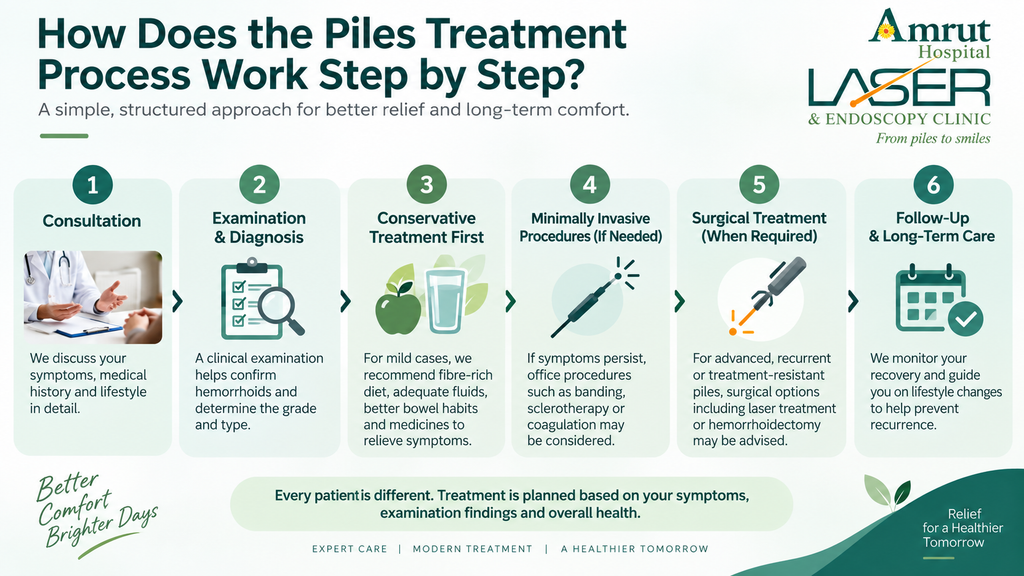
The decision about Piles Surgery in Dombivli should come after diagnosis, not before it.
Step 1: Consultation
The doctor asks about bleeding, pain, constipation, swelling, prolapse, bowel habits and how long the symptoms have been present.
Step 2: Clinical Examination
A physical examination helps determine whether the symptoms are actually due to piles. Depending on the condition, a digital rectal examination or anoscopy may also be advised.
Step 3: Determine Severity
The doctor assesses the type, size and degree of hemorrhoidal prolapse.
Step 4: Try Conservative Treatment When Appropriate
Milder cases may be managed with:
- High-fiber food
- Adequate fluids
- Stool-softening measures when advised
- Avoiding prolonged toilet sitting
- Avoiding unnecessary straining
- Medicines for short-term symptom control
High-fiber foods can help make stools softer and easier to pass, reducing straining during bowel movements.
Step 5: Consider a Procedure
If symptoms persist, office-based procedures such as banding, sclerotherapy or coagulation may be considered for suitable internal hemorrhoids.
Step 6: Consider Surgical Treatment
For advanced, recurrent or treatment-resistant disease, the surgeon may discuss hemorrhoidectomy, laser-based treatment or another suitable technique.
Piles treatment usually follows a step-up approach: diagnosis → lifestyle and medicines → minimally invasive procedures → surgery when clinically required. Surgery should be selected based on severity rather than symptoms alone.
What Are the Benefits of Piles Surgery in Suitable Patients?
When surgery is genuinely indicated, potential benefits may include:
- Better control of persistent bleeding
- Treatment of large or prolapsing hemorrhoids
- Relief from recurring symptoms
- Treatment after conservative measures have failed
- Reduced dependence on repeated temporary treatment
- Improved comfort during bowel movements and daily activities
For selected patients, Laser piles treatment in Dombivli may also be discussed.
Conventional hemorrhoidectomy remains an effective treatment for severe or recurring hemorrhoids, although recovery can involve more postoperative discomfort than less invasive approaches.
Research comparing laser hemorrhoidoplasty with conventional surgery has reported lower short-term pain and faster return to daily activities in some studies. However, newer evidence also suggests that long-term durability and recurrence need to be considered, and the certainty of evidence is not equally strong for every outcome.
So, “laser” should not automatically mean “best.” The better treatment is the one that matches the patient’s condition.
Piles Medicines vs Office Procedures vs Surgery: What Is the Difference?
| Treatment Approach | Commonly Considered For | Main Consideration |
|---|---|---|
| Diet, fibre and lifestyle changes | Mild symptoms | Helps reduce constipation and straining |
| Medicines | Mild pain, itching or swelling | Primarily controls symptoms |
| Rubber-band ligation | Selected bleeding or prolapsing internal piles | Office-based procedure |
| Sclerotherapy/coagulation | Selected internal hemorrhoids | Less invasive than surgery |
| Laser-based procedure | Selected symptomatic hemorrhoids | May offer quicker short-term recovery in suitable patients |
| Hemorrhoidectomy | Large, severe, recurring or treatment-resistant piles | More definitive tissue removal but longer recovery |
No single method is right for everyone. Treatment choice depends on hemorrhoid type, grade, symptoms, previous treatment and the patient’s overall health.
Who Is a Good Candidate for Piles Surgery?
You may need a surgical assessment if:
- Bleeding repeatedly returns
- A pile mass regularly prolapses outside
- Symptoms continue despite conservative care
- Hemorrhoids are large or advanced
- Previous non-surgical treatments have not worked
- The condition frequently interrupts work or daily life
- Your doctor identifies a complication requiring intervention
Imagine someone who has taken constipation medicines and used creams repeatedly for months. Each time, symptoms settle temporarily—but bleeding and prolapse return.
Rather than continuing the same cycle, an examination can determine whether a more definitive treatment is appropriate.
On the other hand, someone with mild symptoms for a few days may only require conservative management.
That difference is why individual evaluation matters.
How Much Does Piles Surgery Cost in Dombivli?
There is no single fixed cost for Piles Surgery in Dombivli because treatment varies from patient to patient.
Pricing may depend on:
- Type and grade of hemorrhoids
- Treatment technique selected
- Laser or conventional procedure
- Diagnostic tests required
- Anaesthesia
- Hospital or day-care charges
- Medicines
- Medical conditions requiring additional monitoring
- Follow-up requirements
- Insurance coverage, if applicable
A consultation and examination should therefore come before an accurate treatment estimate.
Choosing treatment only because one procedure appears cheaper—or because another is advertised as more advanced—may not lead to the right clinical decision.
What Are the Piles Treatment Trends in 2026?
In 2026, hemorrhoid care continues to move toward individualised and minimally invasive treatment whenever clinically appropriate.
Laser hemorrhoidoplasty and other tissue-preserving approaches have attracted attention because some studies report less early postoperative pain, shorter procedures and quicker return to routine compared with conventional hemorrhoidectomy.
But current evidence also highlights an important trade-off.
Amrut Hospital | Piles Fistula and Fissure Doctor in Dombivli
Address: Dr R.P. Rd, Dombivli, Tilak Nagar, Dombivli East, Kalyan, Maharashtra 421201
Phone: 087796 02217