
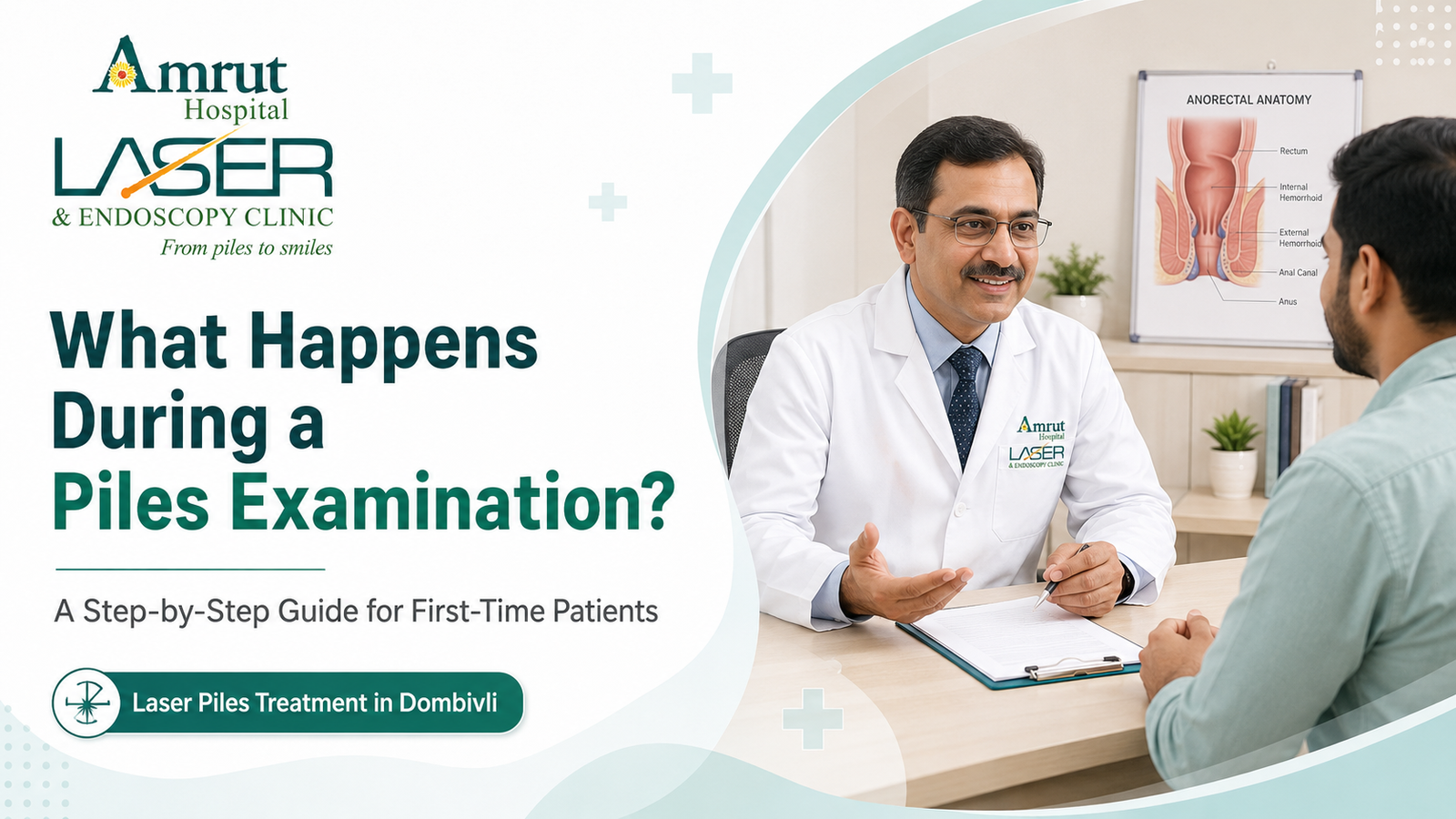
For many people, the hardest part of dealing with piles is deciding to speak to a doctor. An examination can feel awkward, especially the first time. You may wonder: Will it hurt? What will the doctor check? Does an examination automatically mean surgery?If treatment is needed, the findings help decide whether lifestyle changes, medicines, an office procedure, conventional surgery or laser piles treatment in Dombivli may be suitable. At Amrut Hospital, the first step is diagnosis—not guesswork.If you are considering laser piles treatment in Dombivli, the first step is usually a proper piles examination. It helps the doctor understand your symptoms, identify the type and grade of piles, and decide which treatment may be suitable.
Usually, a piles evaluation is straightforward. It helps identify the reason behind bleeding, itching, swelling, pain or a lump near the anus and shows whether the problem is internal piles, external piles, a fissure, fistula or something else.
What Happens During a Piles Examination?
A piles examination usually begins with questions about bleeding, pain, bowel habits and constipation, followed by visual inspection of the anal area. A doctor may then perform a gentle digital rectal examination and, when needed, anoscopy to view internal hemorrhoids. Further tests are recommended only when clinically necessary.
What Is a Piles Examination?
A piles examination checks whether anal or rectal symptoms are caused by hemorrhoids and, if so, what type and grade they may be.
External piles can often be seen during inspection. Internal piles may require a digital rectal examination and sometimes anoscopy for a clearer view of the anal canal and lower rectum.
Rectal bleeding should not automatically be assumed to be piles. Further evaluation may be needed when the history or examination suggests another cause. Current clinical guidance specifically recommends considering other causes of rectal bleeding where appropriate.
Why Is a Proper Piles Examination Important Before Treatment?
A good examination gives the doctor more information than symptoms alone.
- Confirms the likely cause: Bleeding, pain and itching can occur with conditions other than piles.
- Identifies internal or external piles: Treatment may differ depending on location and grade.
- Checks prolapse: The doctor may assess whether piles come out during straining or remain outside.
- Looks for complications: A painful lump may suggest a thrombosed external hemorrhoid.
- Guides treatment choice: Mild disease may respond to fiber, fluids and bowel-habit changes.
- Avoids unnecessary procedures: Not everyone visiting a Piles clinic in Dombivli needs surgery.
- Helps assess bleeding safely: Selected patients may need further bowel evaluation.
Clinical guidelines support fiber and behavioral changes as first-line care for many patients. A Cochrane review cited in ASCRS guidance found fiber reduced the risk of persistent hemorrhoid symptoms by 53%.
Mini Summary: A piles examination helps confirm the diagnosis, understand the grade and rule out other causes of pain or bleeding. Only after that should treatment—including laser treatment—be discussed.
How Does a Piles Examination Work Step by Step?
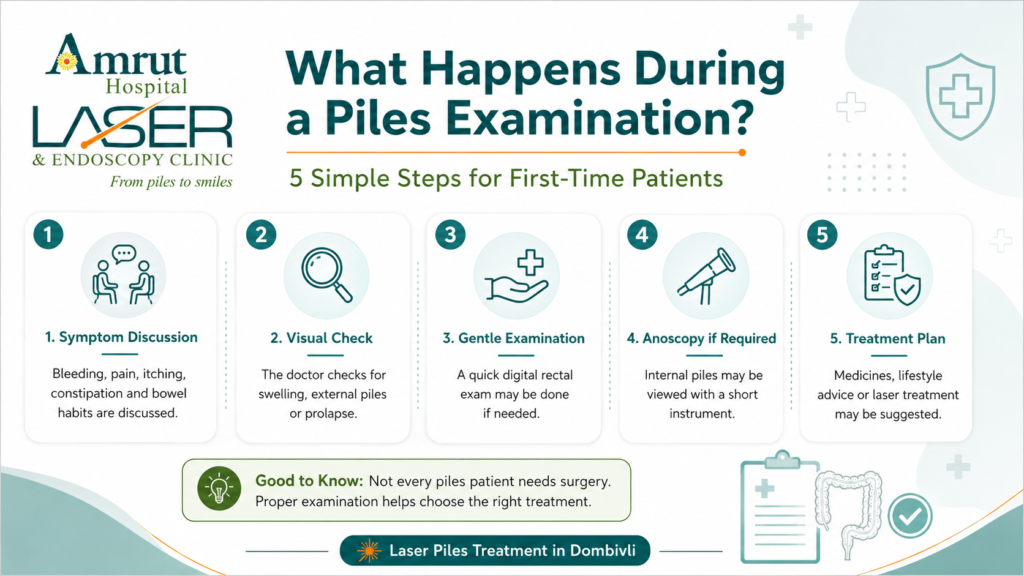
Knowing what happens during the appointment can remove a lot of unnecessary fear.
Step 1: Your Symptoms Are Discussed
Your Piles doctor in Dombivli may ask about bleeding, pain, itching, swelling, constipation, hard stool, straining, mucus or tissue coming out during bowel movements.
Diet, medicines, toilet habits and any previous piles treatment may also be discussed. A detailed medical history is considered an important part of hemorrhoid diagnosis.
Step 2: Visual Inspection
The doctor may check for swelling, external piles, prolapse, irritation, fissures or a thrombosed hemorrhoid. You may be asked to lie on your side.
This simple examination can provide useful clues, particularly when external hemorrhoids or prolapse are present
Step 3: Digital Rectal Examination
If appropriate, a lubricated, gloved finger is gently inserted into the rectum to assess tenderness, muscle tone and unusual lumps. Tell the doctor if you have severe pain.
A digital rectal examination can also help the doctor check for other anorectal abnormalities rather than assuming every symptom comes from piles.
Step 4: Anoscopy or Proctoscopy When Needed
For suspected internal piles, a short instrument may be used to view the anal canal and lower rectum. Anoscopy is often performed without anaesthesia.
It allows the doctor to see hemorrhoidal tissue that may not be clearly visible during an external examination.
Step 5: Further Tests Only When Indicated
Not every patient needs colonoscopy or endoscopy.
Further evaluation may be advised when:
- The source of bleeding is unclear
- Symptoms suggest another bowel condition
- Bleeding continues despite treatment
- There are relevant abdominal symptoms
- Colorectal screening is due
Current hemorrhoid guidelines recommend complete colon evaluation only in selected patients rather than routinely for everyone with piles symptoms.
Step 6: A Treatment Plan Is Made
Once the diagnosis is clear, the doctor can discuss lifestyle care, medication, procedures or laser piles treatment in Dombivli.
This is why examination comes first. Treatment should match the condition instead of being chosen simply because a procedure sounds newer or more convenient.
What Are the Benefits of Getting Piles Diagnosed Early?
Early assessment can save patients from repeated self-treatment.
- The real cause of symptoms becomes clearer.
- Treatment can be matched to the hemorrhoid grade.
- Constipation and straining habits can be corrected early.
- Persistent bleeding can be investigated properly.
- Unnecessary creams or home remedies can be avoided.
Imagine noticing blood every few weeks and changing creams each time. If it keeps returning, an examination is more useful than another temporary fix.
More importantly, repeated rectal bleeding should never simply be labelled as piles without appropriate assessment.
How Does Laser Piles Treatment Compare With Conventional Surgery
Treatment should be selected according to hemorrhoid anatomy, grade and patient needs. Laser is not automatically the best option for everyone.
| Factor | Laser Piles Treatment | Conventional Hemorrhoidectomy |
|---|---|---|
| Approach | Minimally invasive in selected cases | Hemorrhoidal tissue is surgically removed |
| Early pain | Often lower in comparative studies | Usually greater during early recovery |
| Wound | No large excisional wound with laser hemorrhoidoplasty | Surgical wound is expected |
| Return to routine | Often earlier | May take longer |
| Long-term control | Effective in selected patients; recurrence varies | Important option for selected advanced disease |
| Best choice | Based on examination and anatomy | Based on severity and surgeon assessment |
Clinical recommendations and recent studies suggest laser hemorrhoidoplasty may offer lower postoperative pain and earlier recovery because it is a tissue-preserving approach. However, disease grade, prolapse and recurrence risk still need to be considered.
Who Is a Good Candidate for Laser Piles Treatment?
A patient may be considered for a laser operation for piles in Dombivli when examination confirms hemorrhoids suitable for a minimally invasive approach.
Possible candidates include people with:
- Symptomatic internal hemorrhoids
- Recurrent bleeding caused by confirmed piles
- Selected prolapsing hemorrhoids
- Symptoms not improving enough with conservative care
- A need for procedural treatment after clinical evaluation
Some advanced or significantly prolapsing piles may require another surgical approach. Even modern laser recommendations emphasize appropriate patient selection rather than treating every grade in exactly the same way.
The right candidate is decided after examination, not from symptoms alone.
What Affects the Cost of Piles Examination and Laser Treatment in Dombivli?
There is no single price because evaluation and treatment differ from patient to patient.
Common factors include:
- Grade and number of hemorrhoids
- Internal, external or mixed disease
- Need for anoscopy, proctoscopy, blood tests or other investigations
- Type of anaesthesia
- Procedure selected
- Hospital or operating-room requirements
- Medicines and follow-up care
- Insurance or cashless eligibility, where applicable
Amrut Hospital also notes that the severity of piles, investigations required and the patient’s overall health can influence the final treatment plan and cost.
A consultation at a Piles hospital in Dombivli allows the hospital to provide an estimate based on the actual diagnosis rather than a generic online package.
What Are the Piles Treatment Trends in 2026?
In 2026, piles care is increasingly focused on individualised, minimally invasive treatment with careful patient selection.
Recent clinical recommendations for laser hemorrhoidoplasty emphasize standardised technique, pre-operative assessment, procedural safety and postoperative care.
A 2026 observational study involving 77 patients reported low postoperative pain and quick return to normal activity for many patients. The study reported a 9.1% clinically confirmed recurrence rate at one year, but the researchers also highlighted its small, single-centre design and called for larger comparative studies with longer follow-up.
A better question is: Which treatment gives this patient the right balance of comfort, recovery and durable symptom control?
That patient-first approach is becoming more important than simply labelling one procedure as “modern” and another as “old.”
Why Choose Amrut Hospital in Dombivli?
Amrut Hospital in Dombivli East provides care for piles, fissure, fistula and general surgical conditions, with laser, endoscopy and laparoscopic services available.
For a first-time patient, the journey can begin with proper examination rather than assumptions. If laser piles treatment in Dombivli is suitable, it can be discussed after the hemorrhoid type and grade are clear.
Amrut Hospital is associated with Dr. Pramod Bahekar and provides laser and endoscopy care
Other surgical services include access to a Hernia surgeon in Dombivli, Laparoscopic surgeon in dombivli and Endoscopic surgeon in dombivli.
The goal is simple: understand what is causing your symptoms, explain your options clearly and then choose treatment according to your clinical needs.
FAQs About Piles Examination and Treatment
1. Is a piles examination painful?
It may cause mild discomfort, but it is generally brief. Pain depends on the condition present. If you have severe pain or an acute fissure, tell the doctor so the examination can be adapted.
2. Do I need to prepare before visiting a piles doctor?
Usually, no complicated preparation is needed. Bring details of your symptoms, medicines, previous treatment and reports. The clinic will advise if special preparation is required.
3. Can a doctor diagnose piles without a colonoscopy?
Yes. Many hemorrhoids can be diagnosed through medical history, visual examination, digital rectal examination and anoscopy. Colonoscopy is used selectively when symptoms or screening needs justify a more complete bowel evaluation.
4. Does Having Piles Mean I Will Need Laser Surgery?
No. Many patients improve with fiber, fluids, better toilet habits and conservative treatment. Laser or surgery is considered when symptoms, grade and response to non-operative care support it.
5. When Should I Visit a Piles Clinic in Dombivli?
Consider an examination if you have repeated rectal bleeding, persistent itching, swelling, pain, a lump or tissue coming out during bowel movements.
Heavy bleeding, black stools, significant dizziness or weakness, or severe worsening pain should receive prompt medical attention rather than being assumed to be routine piles symptoms.
Book a Piles Consultation at Amrut Hospital
Embarrassment should not keep you guessing about symptoms that continue to return.
If you have bleeding, pain, itching, swelling or a lump near the anus, book an evaluation at Amrut Hospital, Dombivli. A proper examination can identify the cause and help determine whether conservative care or laser piles treatment in Dombivli is appropriate.
Get examined first. Understand your options. Then choose treatment with confidence.