Going to the gym is usually associated with better health. But what happens when a heavy squat, deadlift or leg press leaves you with discomfort, itching or bleeding around the anal area?
For someone who already has piles, heavy weightlifting may sometimes make symptoms more noticeable. The issue is usually not exercise itself. The bigger concern is repeated straining, holding your breath during heavy lifts and putting excessive pressure on the abdomen and pelvic area.
You may first notice mild discomfort after training and assume it will settle on its own. But if bleeding, swelling, pain or a lump near the anus keeps returning, ignoring it may allow the problem to become more troublesome.
Heavy lifting is recognised as one of the factors associated with hemorrhoids, along with constipation, straining during bowel movements and prolonged sitting on the toilet.
If symptoms are interfering with your workouts or everyday routine, getting evaluated at a piles surgery in Dombivli can help you understand the actual cause and whether lifestyle changes, medicines or a procedure such as laser piles treatment in Dombivli may be appropriate.
Can Heavy Gym Workouts Actually Make Piles Worse?
Heavy gym workouts do not automatically cause piles in every person. However, repeated heavy lifting combined with breath-holding and straining can increase pressure around the rectal veins. If piles are already present, this pressure may aggravate bleeding, swelling, irritation or prolapse.
The National Institute of Diabetes and Digestive and Kidney Diseases lists frequent heavy lifting among factors associated with hemorrhoids.
What Are Piles and How Are They Connected to Weightlifting?
Piles, also called hemorrhoids, are swollen blood vessels in or around the anus and lower rectum. They may be internal, meaning they develop inside the rectum, or external, where they form under the skin around the anus.
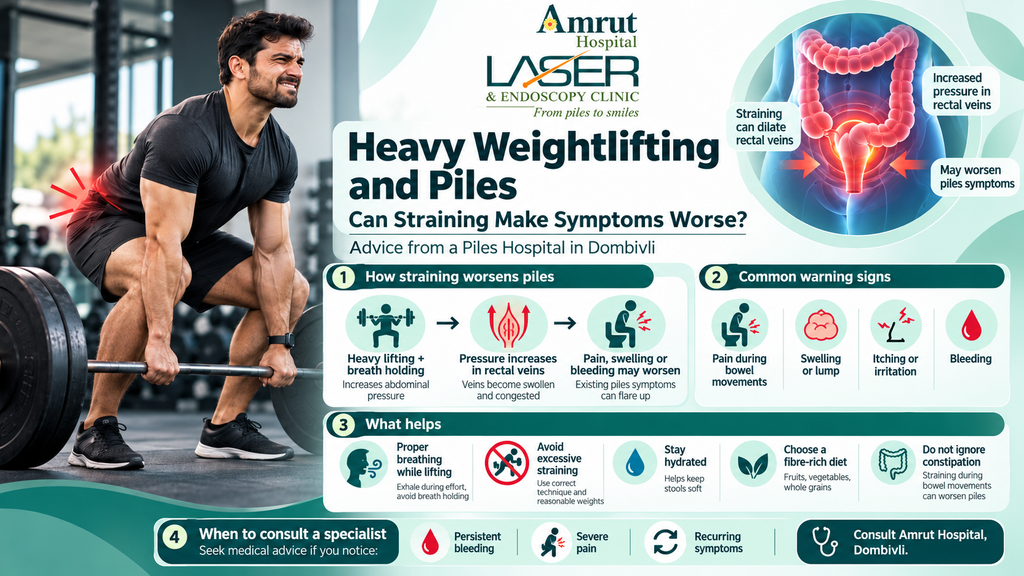
During a very heavy lift, people often tighten their abdominal muscles and hold their breath to stabilise the body. This creates increased pressure inside the abdomen.
Think about a person attempting a heavy deadlift. As the weight comes off the floor, they may hold their breath and strain intensely. Doing this repeatedly can add pressure to an already irritated hemorrhoidal area.
That does not mean you need to give up strength training completely. It means technique, breathing, weight selection and existing symptoms need attention.
Heavy lifting does not mean everyone will develop piles. But frequent straining, constipation and repeated high abdominal pressure may contribute to symptoms or make existing hemorrhoids more uncomfortable.
Why Can Heavy Weightlifting Trigger or Worsen Piles Symptoms?
Several gym habits may increase strain on the rectal area:
- Holding your breath while lifting: Breath-holding during a difficult repetition increases abdominal pressure.
- Lifting beyond your current capacity: Excessively heavy loads often lead to uncontrolled straining.
- Poor lifting technique: Incorrect posture can cause unnecessary pressure throughout the abdomen and pelvic floor.
- Chronic constipation: High-protein diets with inadequate fibre or fluids may make stools harder in some people.
- Dehydration: Training hard without replacing enough fluids may contribute to constipation.
- Ignoring the urge to pass stool: Delaying bowel movements can make stools harder and increase straining later.
- Existing hemorrhoids: Heavy lifting may make existing bleeding, swelling or prolapse more noticeable.
Current gastroenterology guidance continues to recommend increasing dietary fibre and avoiding excessive straining as first-line steps for symptomatic hemorrhoids.
What Happens When You Visit a Piles Hospital in Dombivli?
Treatment should not begin simply because someone notices bleeding after a workout. Rectal bleeding and anal discomfort can have several causes.
A typical evaluation may involve:
Step 1: Discussing your symptoms
The doctor may ask about bleeding, pain, constipation, bowel habits, gym routine, duration of symptoms and whether any tissue comes out during bowel movements.
Step 2: Clinical examination
The anal and rectal area may be examined to identify hemorrhoids or another possible condition.
Step 3: Determining the grade of piles
Internal piles are commonly classified from Grade I to Grade IV depending on the amount of prolapse and whether they return inside naturally.
Step 4: Ruling out other conditions
Sharp pain while passing stool, for example, may be associated with an anal fissure rather than piles. Updated 2026 American Gastroenterological Association guidance also stresses the importance of accurate examination before treating suspected hemorrhoids.
Step 5: Choosing treatment
Early symptoms may improve with dietary changes, better bowel habits and medicines. Persistent or advanced piles may require an office procedure or surgery.
What Are the Benefits of Getting Piles Evaluated Early?
Seeking medical advice early can help you:
- Find the actual reason for bleeding or pain
- Know whether you have piles, fissure or another condition
- Prevent repeated straining from worsening symptoms
- Correct constipation and bowel habits
- Understand whether you can safely continue strength training
- Receive treatment based on the grade of piles
- Discuss minimally invasive options when clinically suitable
Most importantly, you do not have to keep guessing every time symptoms return after a workout.
Laser Piles Treatment vs Conservative Treatment vs Surgery
Treatment depends on the grade, symptoms and findings during examination.
| Treatment approach | Usually considered for | Key point |
|---|---|---|
| Lifestyle and dietary changes | Mild or early symptoms | Focuses on fibre, hydration and reducing straining |
| Medicines or topical treatment | Selected symptomatic cases | May provide temporary symptom relief |
| Office-based procedures | Certain Grade I–III hemorrhoids | Options may include banding or infrared coagulation |
| Laser piles treatment | Selected symptomatic piles | Minimally invasive option in appropriately chosen patients |
| Conventional hemorrhoidectomy | Large, prolapsing or advanced piles | May be preferred for some advanced cases |
The 2026 AGA expert review notes that office procedures such as rubber-band ligation or infrared coagulation are often considered before surgical hemorrhoidectomy for Grade I–III hemorrhoids, while Grade IV disease generally requires surgical assessment.
Research on laser hemorrhoidoplasty suggests it can offer less postoperative pain and faster return to routine activities in selected cases. However, evidence also suggests conventional surgery may offer better durability in some advanced disease. Treatment therefore needs to be individualised rather than assuming laser is automatically best for everyone
There is no single piles treatment that suits every patient. The right option depends on the grade of hemorrhoids, severity of symptoms, associated external disease and previous treatments.
Who Should Consult a Doctor for Gym-Related Piles Symptoms?
Consider an evaluation if you experience:
- Repeated bleeding during or after bowel movements
- A lump or swelling around the anus
- Itching or irritation that keeps returning
- Tissue coming out while passing stool
- Persistent discomfort while sitting
- Symptoms that become worse after heavy lifting
- Constipation with regular straining
- Symptoms that do not improve despite fibre and hydration
Severe anal pain with rectal bleeding, especially when accompanied by abdominal pain, diarrhoea or fever, should receive prompt medical attention.
You should also avoid assuming that every episode of bleeding is piles. Proper diagnosis matters.
How Much Does Piles Treatment in Dombivli Cost?
The cost of piles treatment in Dombivli cannot be determined accurately without examination because treatment varies from person to person.
Factors that can affect pricing include:
- Grade and type of hemorrhoids
- Whether piles are internal, external or both
- Treatment technique recommended
- Need for laser or conventional surgery
- Anaesthesia requirements
- Hospital stay
- Diagnostic investigations
- Medicines and postoperative care
- Associated conditions such as fissure or fistula
A consultation is therefore more useful than choosing treatment purely on the basis of an advertised package price.
What Are the Piles Treatment Trends in 2026?
In 2026, hemorrhoid care is increasingly focused on matching the procedure to the individual rather than using one technique for everyone.
Recent clinical guidance continues to support lifestyle measures such as fibre intake and reducing straining as the foundation of treatment. Office-based procedures remain important for suitable lower-grade hemorrhoids.
At the same time, interest in minimally invasive options such as laser hemorrhoidoplasty continues to grow. International recommendations have been developed to standardise how laser hemorrhoidoplasty is performed.
A 2026 systematic review of 15 randomised trials involving 1,099 patients found laser hemorrhoidoplasty was associated with lower early postoperative pain and quicker return to daily activities compared with conventional hemorrhoidectomy. However, researchers also cautioned that long-term durability remains less certain.
For patients, the key trend is simple: personalised treatment based on diagnosis and disease severity is more important than simply choosing the newest procedure.
Why Choose Amrut Hospital in Dombivli?
If piles symptoms repeatedly interfere with your workouts, workday or bowel routine, getting them evaluated can provide clarity.
Amrut Hospital in Dombivli provides consultation and treatment for piles and other surgical and gastrointestinal conditions. Patients looking for Piles Surgery in Dombivli, Piles treatment in Dombivli,
or Laser piles treatment in Dombivli can discuss the appropriate treatment after clinical evaluation.
Depending on the diagnosed condition and medical indication, patients may also require evaluation for services such as Laser Fissure Surgery in Dombivli, fissure treatment in Dombivli, Anal Cancer Surgery in Dombivli, Hemorrhoids treatment in Dombivli, Hernia Surgery in Dombivli, Gallbladder Surgery in Dombivli, Endoscopy Surgery in Dombivli, Laparoscopic Surgery in Dombivli or Fistula Laser Surgery in Dombivli.
The important part is getting the diagnosis right before deciding on a procedure.
FAQs About Heavy Weightlifting and Piles
1. Can heavy weightlifting cause piles?
Frequent heavy lifting is associated with hemorrhoids because repeated straining can increase pressure in the abdominal and rectal area. However, piles usually develop due to several contributing factors rather than one workout alone.
2. Should I stop going to the gym if I have piles?
Not necessarily. Many people can continue appropriate physical activity. However, if heavy lifting causes bleeding, pain or prolapse, reduce strenuous lifting and speak with a doctor before returning to high-intensity training.
3. Can squats and deadlifts worsen hemorrhoids?
Heavy squats and deadlifts may aggravate symptoms when they involve excessive straining or breath-holding, especially if hemorrhoids are already present. Proper breathing, gradual progression and avoiding unnecessary straining can help.
4. When should I consider laser piles treatment in Dombivli?
Laser treatment may be considered for selected patients with symptomatic hemorrhoids after clinical examination. The grade of piles, extent of prolapse, external components and previous treatments all influence whether laser treatment is suitable.
5. Can piles return after treatment if I continue heavy lifting?
Treatment can address existing hemorrhoids, but habits that contribute to pressure and straining still matter. Maintaining adequate fibre and hydration, avoiding constipation and using correct lifting technique remain important even after treatment.
Take Your Symptoms Seriously Without Giving Up an Active Lifestyle
Being active is good for your health. Piles do not automatically mean you have to stop training.
But repeatedly seeing blood after bowel movements, feeling a painful lump or dealing with discomfort every time you lift heavy weights is not something you should simply learn to tolerate.
If symptoms continue, consult Amrut Hospital for an assessment at a piles hospital in Dombivli. A proper examination can help determine whether simple lifestyle measures are enough or whether treatments such as laser piles surgery in Dombivli or Piles Surgery in Dombivli should be considered.
Book a consultation with Amrut Hospital in Dombivli to understand the cause of your symptoms and discuss the treatment option appropriate for your condition.
For further information contact:
Amrut Hospital | Piles Fistula and Fissure Doctor in Dombivli
Address: Dr R.P. Rd, Dombivli, Tilak Nagar, Dombivli East, Kalyan, Maharashtra 421201
Phone: 087796 02217